

Lake Hashenge was chosen to die. Now its people are fighting to bring it back to life.
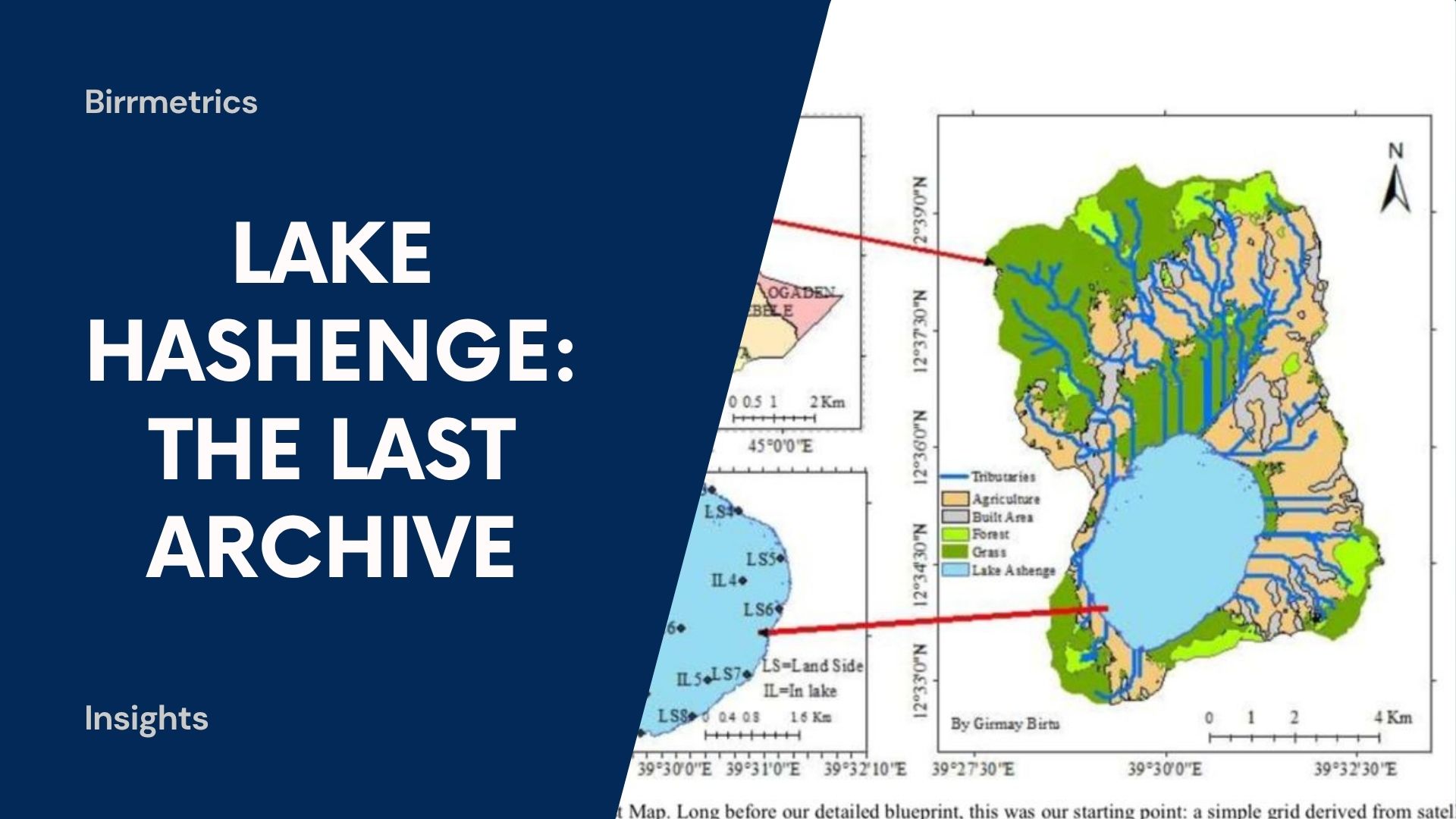
From space, it still looks like a lake, a blue eye set high on the Raya plateau, cradled by the Rayan chain mountains above 3,400 meters, commanding a rare 360- degree horizon. But the data tells a different story, one of slow, deliberate suffocation. Since 1990, Lake Hashenge has lost 64% of its water, its depth now ranges from a critically shallow 1.9m to a maximum of 20m, based on our field assessment. Yet, paradoxically, its surface has grown by 18.75%. Scientists call this a hydraulic illusion, the terminal stage of collapse in a closed highland basin, where a lake spreads thin as it dies from within. From satellite images, it appears intact. On the ground, it is a living archive in its death throes. This is not a story of accidental environmental decline. It is a story of political choice. For decades, this highland system, an internationally recognized Key Biodiversity Area, a site of planetary science, unique evolution and ancient civilization, was managed not for survival, but for disappearance. Lake Hashenge is not one place, but three layered worlds.
First, a planetary archive. Its alkaline, magnesium-rich waters preserve living stromatolites, layered microbial structures that are Earth’s oldest fossils. These same formations are now a key focus for NASA, as direct analogues for minerals found in Mars’ Jezero Crater. This irreplaceable record is being buried under silt at a rate of 2–3 cm per year. Second, an evolutionary and ecological archive. In its remaining deep pockets swims the Hashenge Garra, a small, modest fish found absolutely nowhere else. Its population has crashed by 89% since 2005. In 2024, researchers found nearly zero juvenile fish, a sign of reproductive collapse. The lake is also a confirmed Key Biodiversity Area (KBA), designated in 2011 for its critical importance to bird-life. It supports 36 documented waterbird species, representing 21% of Ethiopia’s known waterbird diversity.
Nearly half are migratory, including globally Near- infrastructure specialist, and founder and Board chairman of LHRDI Threatened species such as the Ferruginous Duck and Maccoa Duck. This vital stopover on the Afro-Eurasian flyway is now collapsing under the same silt and chemicals that are killing the lake—a direct violation of its international conservation status. Third, a human archive. On its western shore stand the ruins of Mifsas Bhri, two-storey complex palaces, a church, and kitchen where artifacts where left in place, a complete 6th century Aksumite southern kingdom, its age confirmed carbon dating.
The site was formally excavated and documented by Mekelle University, Addis Ababa University, and German’s Heidelberg University (2013 to 2015). In 2024, a three-metre section of the palace wall crumbled after torrents of silt-laden runoff undermined its base. It was not worn down by centuries, but undermined in a decade by torrents of silt-laden runoff due to deliberate governance vacuum. The regional state had certified the archive’s antiquity, only to become the primary agent to its annihilation. The mechanism of erasure was methodical, and politically designed. First, the watershed was stripped with state permission. The Maichew Particleboard Factory, owned by the EFFORT endowment of the Tigray People’s Liberation Front (TPLF), clear-cut thousands of hectares of watershed forest under the Tigray regional government’s oversight.
Satellite data shows forest cover plummeting from 34% to 11% in three decades. The result: an estimated 31,200 tons of soil now wash into the lake annually. Second, agriculture poisoned the water under regional policy. A Tigray regional state push for agricultural intensification, without environmental safeguards, increased fertilizer use in the catchment by 400% between 2000 and 2019. The lake transformed into an oxygen- starved algal soup. This threat was explicitly warned about in the lake’s 2011 Key Biodiversity Area assessment, yet no regional action followed.
Third, and decisively, the regional state engineered a governance vacuum. Lake Hashenge lies within Tigray’s jurisdiction. Yet no regional bureau, not Environment, Water, Agriculture, nor Culture, accepted responsibility. This was not an oversight. It was regional policy: in the politically contested Raya area, long-term environmental investment was avoided. The lake was deliberately left without a legal guardian. This neglect stands in stark contrast to the Tigray government’s own actions elsewhere. Despite an active regional water and energy bureau and demonstrated capacity to construct and maintain artificial reservoirs across Tigray, Lake Hashenge, the region’s only natural and historical lake, was singled out for abandonment.
The hydraulic illusion served this politics perfectly. The regional authorities could point to the lake’s persistent blue shape on maps as “proof” it still existed, while beneath the surface, it was suffocating. The regional state chose to see a lake on paper, and ignore the one dying in reality. This is the core of the political ecology: Lake Hashenge was not neglected because restoration was impossible. It was neglected because the Tigray regional state chose not to restore it. In a contested territory, the lake’s death was politically convenient. The death of a lake is never just ecological. As Hashenge suffocated, the social fabric of the Raya Valley unraveled.
Fisheries that sustained hundreds of families vanished. The breathtaking tourism potential of its 360-degree mountain vistas was never realized. With livelihoods gone, the young began to leave. Local surveys indicate 50%+ of 18–30 year olds have left or plan to leave, many on perilous journeys to the Arabian Peninsula. Community health workers now speak of “ecological grief”—a profound, collective sorrow at watching a foundational landscape die. “The lake was our memory,” one elder told us. “Without it, we are forgetting who we are.” When the state’s guardians were absent by design, new guardians emerged—not from politics, but from the community itself. The Lake Hashenge Restoration and Development Initiative (LHRDI) was formed by 31 Raya professionals—scientists, engineers, lawyers, historians. We documented the collapse and designed a scientific restoration blueprint. Then, a pivotal validation came. Raya University and the Ethiopian Biodiversity Institute, both federal research bodies, reviewed our approach and framework.
In official letters, they formally endorsed LHRDI’s legal establishment. This was not mere support. It was a federal institutional transfer of custodial mandate to where it could actually function: the community on the ground. Our authority now comes not from political permission, but from institutional recognition of a crisis, and of our capacity to fix it. We are not trying to return to a lost past. We are designing a new future. Our blueprint is precise: rebuild watershed forests, intercept silt, revive microbial systems, transition to chemical-free agriculture, and establish community-led, science-based governance.
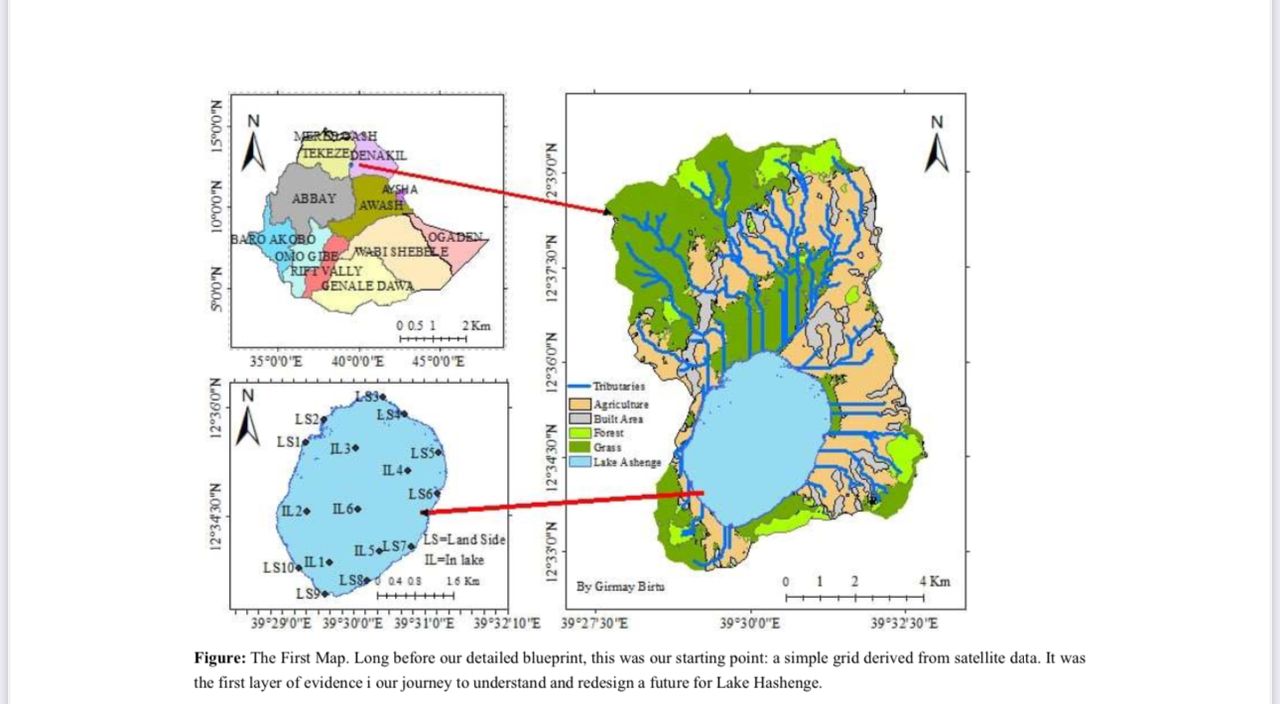
We are creating infrastructure for ecotourism that makes the lake’s health its primary economic asset. This is restoration as infrastructure, not conservation as restriction. the first layer of evidence in our journey to understand and redesign a future for Lake Hashenge. We stand now between two endings. One ending concludes the erasure: the stromatolites buried, the Hashenge Garra declared extinct, the last palace wall collapsed into mud, the Raya youth dispersed, the illusion finally evaporating to reveal a toxic pond. The other ending is governed by what we call the Hashenge Garra Principle: When a place holds universal significance, its protection becomes a universal responsibility.
When a community chooses stewardship, their authority becomes legitimate governance. Lake Hashenge was chosen to die by political neglect. We have chosen it to live through deliberate design. But this choice cannot be ours alone. The planetary archive belongs to every scientist searching for life beyond Earth. The evolutionary archive belongs to biology. The human archive belongs to us all. The hydraulic illusion is over. The design for life has begun. We have the evidence. We have the blueprint. We have the will. The only question remaining is whether the world will join us in the deliberate, collective work of bringing a world back to life.
------
The authors, By Tafere Hiluf Alemie (Eng’r) &
Girmay Birtu (PhD candidate), of this article can be reached via grandtafere@gmail. com.




