As numerous vehicle showrooms fall silent across Addis Ababa, a regulatory crackdown intended to formalise the automobile trade is reshaping the market. Prices of some popular vehicles have climbed sharply, others have fluctuated, and smaller dealers are struggling to survive. Behind the disruption lies a deeper collision between Ethiopia’s electric-vehicle ambitions, foreign-exchange reforms and the realities of an industry already under considerable strain.
The once-crowded car showrooms of Addis Ababa are falling silent. In Meskel Flower, Kera, Bulgaria and other established vehicle-trading districts, premises that previously displayed rows of imported automobiles have closed, emptied their compounds or significantly reduced their operations. The buyers who once wandered between vehicles comparing prices and negotiating deals have largely disappeared from some of the capital’s traditional trading centres.
For years, these neighbourhoods served as the commercial heart of Ethiopia’s automobile market. Importers, dealers, brokers and customers gathered in closely connected networks that facilitated transactions involving vehicles worth millions of birr. Today, many of those businesses are confronting an uncertain future as the government moves to dismantle longstanding commission-based trading practices.
The disruption follows a regulatory crackdown by the Addis Ababa City Administration Revenue Bureau, which has restricted the sale and display of vehicles on premises operated by brokers without the appropriate dealership licences. The measures are part of a wider government effort to formalise commercial transactions, strengthen tax collection and curb practices that authorities say have enabled revenue leakage.
Nearly seven weeks after the enforcement campaign began on August 20, the automobile trade remains unsettled. Although authorities subsequently allowed some affected businesses to reopen under revised conditions, the restrictions have fundamentally changed how many dealers can operate.
The immediate consequences extend beyond locked gates and vacant display spaces. Vehicle prices have become increasingly unpredictable, businesses face mounting operating costs, and consumers are struggling to navigate a market already transformed by restrictions on petrol-powered car imports and a rapid shift towards electric vehicles.
For the government, the crackdown represents another step towards building a transparent and taxable automobile market. For traders, it is an expensive and disruptive restructuring that threatens businesses built over decades. To officials, the crackdown promises a more transparent and taxable car market. To traders, it is an expensive upheaval that threatens livelihoods built over decades. The test is whether formalisation produces real competition—or merely shifts the market from thousands of intermediaries to a smaller, costlier network controlled by larger dealers.
The timing is particularly difficult because Ethiopia’s vehicle market is already undergoing its most consequential transformation in years. In 2024, the government introduced a prohibition on imports of petrol- and diesel-powered vehicles, making electric vehicles central to its transport and industrial development strategy. The decision was intended to reduce dependence on imported petroleum, conserve scarce foreign currency and encourage investment in electric mobility.
The transition has unfolded against the backdrop of currency depreciation, limited access to vehicle financing, infrastructure shortages and rising import costs. The latest showroom restrictions have added another layer of disruption to an industry struggling to adjust to several policy changes at once.
An industry brought to a standstill
The enforcement campaign began in August when city revenue authorities ordered commission agents and vehicle brokers to remove third-party vehicles from premises not authorised to operate as dealerships. The order challenged a business model that has dominated the capital’s automobile trade for years.
Traditionally, many vehicle showrooms did not purchase the cars they displayed. Instead, they provided space for importers or private owners to exhibit vehicles, connected prospective buyers with sellers and collected commissions once transactions were completed. For importers, the arrangement eliminated the need to maintain expensive retail premises. For brokers, it created opportunities to earn income without financing large inventories. Buyers could compare models and prices in concentrated trading centres.
However, authorities argue that some commission-based operators were effectively functioning as unlicensed dealerships, creating opportunities for tax avoidance and undocumented transactions. Under the measures, the right to stock, display and sell vehicles from commercial premises is tied to the appropriate business licence and registration. Brokers may facilitate authorised transactions but cannot simply display vehicles belonging to importers and owners as licensed dealerships.
The restrictions initially emptied numerous car lots across the capital. By August 29, established trading areas around Meskel Flower, Gazebo, Arba Minch and Bulgaria had reportedly become unusually quiet as businesses complied with the order. Authorities permitted affected trading centres to resume certain operations from August 30, but maintained restrictions on the commission-based sale of new, zero-mileage vehicles.
For many businesses, reopening under those conditions did not mean returning to normal. A showroom that previously earned commissions from vehicles supplied by several importers could no longer necessarily continue displaying those vehicles. An operator seeking to become a licensed dealership would need to satisfy additional requirements and potentially commit substantially more capital.
Although no comprehensive official tally of permanently closed showrooms has been published, numerous premises have been emptied or forced to alter their operations. Beyond owners and brokers, the industry supports salespeople, mechanics, cleaners, security guards, drivers, administrative workers and vehicle inspection businesses.
For Bersufekad Temesgen, who has spent years observing the market around Meskel Flower, the government’s intentions are understandable, but the commercial consequences are troubling. He acknowledges that extended chains of intermediaries have inflated vehicle prices, sometimes adding as much as 400,000 birr above what might otherwise be considered a reasonable selling price.
“The new law is clearly intended to close that gap,” he says. “However, I remain skeptical as to whether it will succeed to the extent envisioned.”
According to Bersufekad, showroom rents in established trading areas can range between 500,000 and 600,000 birr a month. Businesses required to maintain such premises while losing their traditional commission-based activities may find remaining in operation financially impossible.
“Some commission-based traders may choose to exit the sector altogether,” he warns, “while others could find the market increasingly concentrated in the hands of a select few.”
That risk matters because Ethiopia’s automobile industry is not a conventional competitive market with unrestricted imports and readily available vehicle financing. Supply is influenced by government policy, foreign-exchange availability and individual importers’ ability to finance shipments.
Car prices tell a divided story
The market’s upheaval is perhaps most clearly reflected in vehicle prices. During the first quarter of 2026, some electric models experienced extraordinary increases. According to traders interviewed for the original reporting, a BYD Seagull rose by approximately 500,000 birr in one week in March. Within three months, its price had nearly doubled.
But subsequent vehicle-listing data indicate a more complicated picture. A review of historical asking prices from the Ethiopian market-tracking platform WagaWise suggests that some popular models increased between July and late September or early October, while others declined or fluctuated sharply.
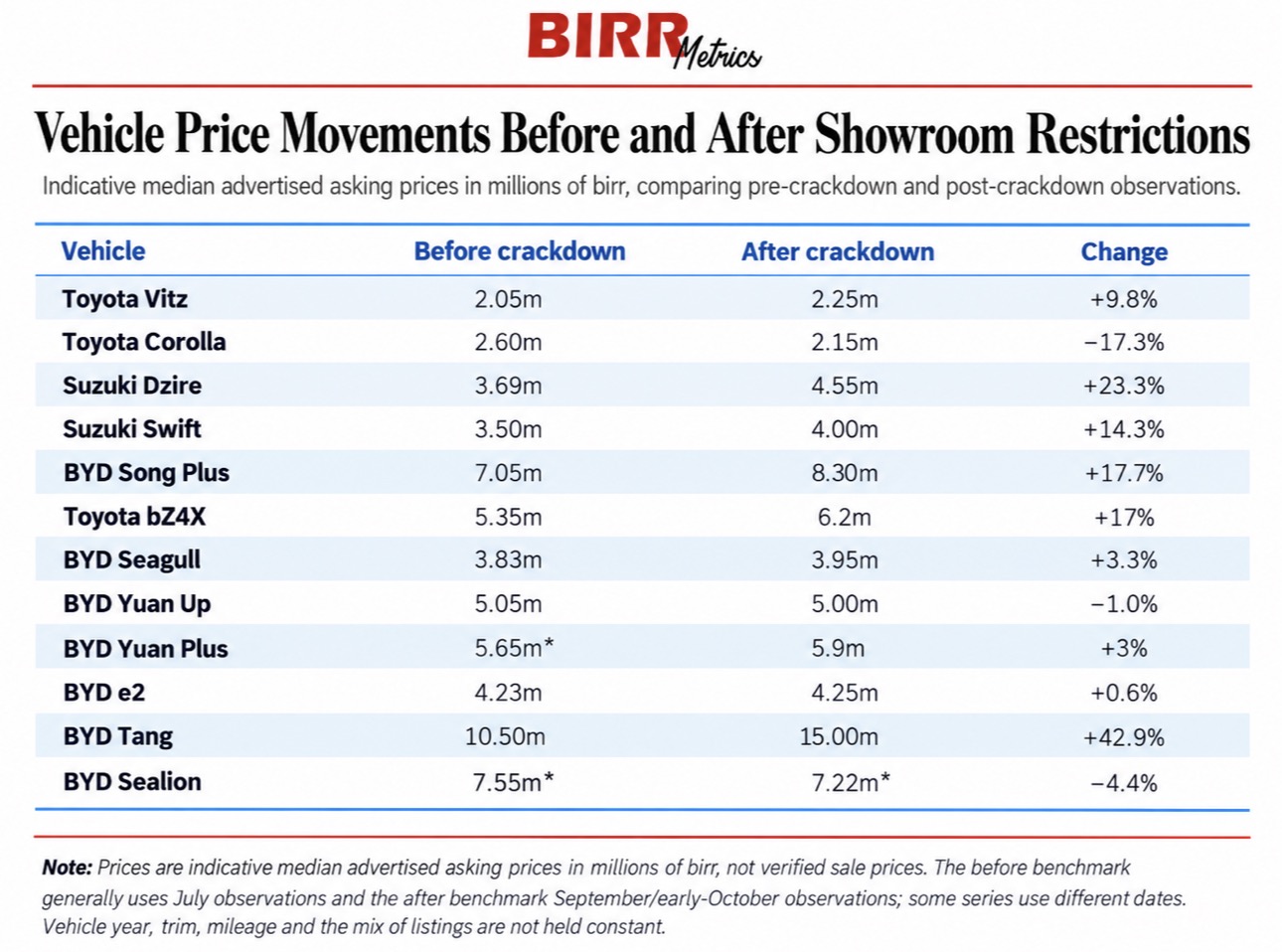
The Suzuki Swift, for example, rose from an observed median asking price of 3.5 million birr in late July to four million birr in the first week of October. The BYD Song Plus increased from 7.05 million to 8.3 million birr over the same broad period. The Suzuki Dzire climbed from approximately 3.69 million birr in July to 4.55 million birr in late September.
By contrast, the BYD Yuan Up remained broadly stable, while the BYD e2 showed only a marginal increase over a longer period. Different segments appear to be reacting differently to currency movements, limited supply, dealer inventory pressures and changing demand.
The differences are significant. The Suzuki Dzire recorded an increase of approximately 860,000 birr, while the BYD Song Plus rose by about 1.25 million birr. The Swift became approximately 500,000 birr more expensive. The BYD Tang showed an even larger increase from around 10.5 million birr in late June to 15 million birr in late September, although the limited number of observations calls for caution.
The Toyota Corolla figures require particular care. The model spans vehicles of different ages, specifications and conditions, so changes in the median listing price may reflect a different selection of vehicles rather than a like-for-like change. Ethiopia lacks an accessible, comprehensive database of confirmed sales prices that would allow buyers to compare matched transactions.
The observed movements do not prove that showroom closures caused changes in prices. Currency depreciation, import restrictions, shifts in demand, dealer inventory and the condition of listed vehicles are all relevant. But the price evidence does show a divided market, not a uniform shock.
Even models with declining quotations remain costly relative to most household incomes. An ageing Toyota Vitz can still approach or exceed two million birr, while compact Suzuki models cost several million birr and larger electric vehicles considerably more.
The foreign-exchange problem beneath the surface
The price instability cannot be understood without examining Ethiopia’s foreign-exchange reforms. The liberalisation of the exchange-rate regime in July 2024 was intended to address longstanding distortions, improve the allocation of foreign currency and reduce the gap between official and parallel-market rates.
For import-dependent businesses, depreciation of the birr has increased the domestic-currency cost of goods purchased abroad. Cars are particularly exposed because their import prices are denominated in foreign currencies and their final retail prices also reflect shipping, insurance, customs charges, financing and distribution.
The International Monetary Fund reported in July 2026 that the birr had depreciated by an average of approximately 1.3 percent a month since October 2025. The Fund also estimated outstanding foreign-exchange backlogs at commercial banks of approximately 1.4 billion US dollars at the end of April 2026.
A dealer selling a vehicle today may need to replace it months later using foreign currency purchased at a different rate. That encourages pricing based on expected replacement costs rather than the original cost of stock. The absence of reliable public pricing information makes it difficult to distinguish reasonable adjustments from excessive markups.
Larger importers with established bank relationships and sufficient working capital may be better positioned to withstand delays. Smaller traders often depend on rapid turnover and commission income without tying up millions of birr in inventory. The latest restrictions have therefore hit operators least able to absorb additional pressure.
Ethiopia’s electric-vehicle gamble
The government’s 2024 decision to restrict imports of petrol- and diesel-powered vehicles was driven by dependence on imported petroleum and the ambition to develop cleaner transport. Electric vehicles promised lower fuel-import requirements, reduced running costs, improved air quality and opportunities for local assembly.
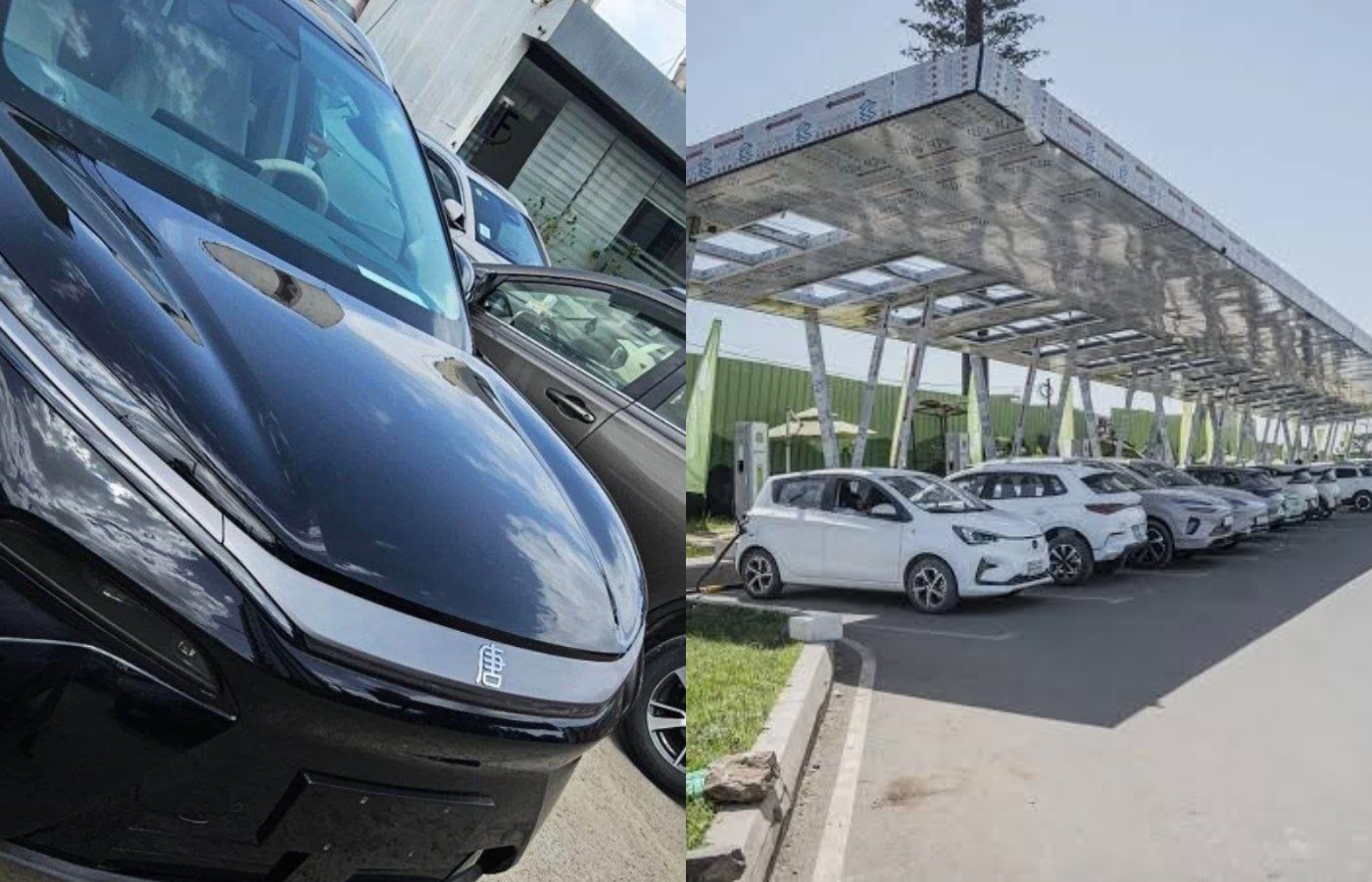
Ethiopia’s largely renewable electricity supply offers a potential advantage. The government introduced favourable customs treatment for electric vehicles and promoted investment in assembly facilities, while BYD emerged as one of the most visible brands in the transition.
But replacing imported conventional cars with imported electric ones does not eliminate foreign-currency dependence. Vehicles, batteries, electrical components and specialist spare parts must still be imported unless domestic production deepens.
For many households, the purchase price remains the chief obstacle. A BYD Seagull may be cheaper to operate than a comparable petrol vehicle, but a price approaching four million birr remains prohibitive for buyers without substantial savings or affordable credit.
The transition risks creating a two-tier market: better-off buyers benefit from lower operating costs while other households remain reliant on ageing conventional vehicles and public transport. Import restrictions have also raised the scarcity value of parts of the existing petrol-vehicle fleet.
Charging infrastructure is unevenly distributed. Urban motorists with dependable home or workplace charging may find electric vehicles viable, but intercity travel depends on functioning chargers along transport corridors. Grid reliability, charger capacity, maintenance and payment access all matter.
Electric cars also require specialised battery and electrical-system servicing, diagnostics and spare parts. Ethiopia’s automotive workforce, traditionally trained on combustion engines, needs investment in technical capacity to support the transition.
Murad Kebede, a mechanic and automobile expert interviewed for the feature, argues that reducing the trade chain could benefit consumers, but questions whether reliable platforms exist for direct transactions between importers and buyers.
“I am not convinced that an adequate platform for such direct engagement has yet been established,” he says. He also points to the weakness of available market information: “Reliable data for meaningful analysis is simply not available.”
As physical showrooms become less active, transactions may shift to dispersed private networks and online listings. Digital marketplaces could improve price discovery if they include verified ownership records, vehicle histories and secure payment arrangements. Without those safeguards they may amplify uncertainty.
Formalisation or market concentration?
The crackdown has a legitimate economic objective. Multiple layers of intermediaries can add unnecessary costs, while undocumented transactions encourage tax evasion and fraud. A formal market could strengthen revenue collection, ownership records and consumer protections.
But the outcome depends on implementation. If smaller operators cannot obtain licences or finance inventory, the market could concentrate among a smaller number of importers and authorised dealers. Larger firms may reduce distribution costs through scale, but weaker competition can also sustain high margins.
Mogos Negash, marketing manager at Halal Car Dealership, views the new framework as an effort to formalise vehicle transactions. “The government’s overarching objective appears to be the formalization of the car trade,” he says.
He points to an alternative based on documented sales from importers to authorised dealers, with dealers adding transparent retail margins. Such arrangements could clarify ownership and tax obligations, but they would not automatically lead to dramatic price cuts because finance, rent, staffing and compliance expenses remain.
The objective should be to eliminate opaque and costly practices, not necessarily useful brokerage services. Intermediaries can connect buyers and sellers, organise inspections and facilitate transactions. The problem is excessive, undocumented or duplicated commissions—not every intermediary role.
The crisis mirrors a broader challenge confronting Ethiopia’s economic transformation. The government is simultaneously liberalising foreign exchange, improving tax compliance, promoting domestic production and changing the composition of vehicle imports. Each measure addresses a real structural problem; together they impose substantial adjustment costs.
For vehicle dealers, foreign-exchange reform raises currency exposure, import restrictions change available stock, electric mobility demands new expertise, and showroom enforcement changes the retail model. Firms with limited capital and weak access to credit are especially vulnerable.
The question is not whether Ethiopia should formalise commerce or pursue electric mobility. It is whether the sequence and pace of reform allow businesses, workers and consumers enough time to adapt. Workers leaving brokerages or showrooms cannot automatically move into EV assembly or specialist maintenance.
Addis Ababa collected approximately 351 billion birr in domestic revenue in the 2025/26 fiscal year and targeted more than 502 billion birr for 2026/27. Stronger enforcement may be necessary, but permanent business closures can also shrink economic activity and undermine the tax base unless viable firms can transition into compliance.
No comprehensive official tally establishes how many vehicle showrooms have permanently closed, reopened under revised licences or laid off staff. Nor is there sufficient public transaction-price data to isolate the price impact of the August measures from currency movements, supply constraints and differences between vehicles.
The success of formalisation should BBC be judged not simply by how many showrooms were cleared, but by whether tax compliance improved, transactions became safer, competition survived and the full cost to consumers declined.
Clear licensing pathways, transparent fees, accessible registration services, verified vehicle listings and realistic arrangements for smaller dealers would help preserve legitimate business activity while curbing abuse.
The authorities also need evidence about employment and market concentration: how many firms have converted their licences, how many remain in business, and whether buyers can still compare competing offers.
The government wants to reduce fuel dependence, encourage electric vehicles, collect more tax and modernise the automobile trade. Those ambitions need not conflict. But an industry cannot easily absorb currency depreciation, import restrictions, financing constraints and new trading rules without friction.
The empty showrooms of Addis Ababa are more than the visible signs of a struggling industry. They expose the difficult trade-offs of reform in a market where affordability, competition, compliance and industrial ambition are all under pressure.
The danger is not simply that cars become more expensive. It is that Ethiopia emerges with a more formal and technologically modern vehicle market that has fewer competitors and remains beyond the reach of most households.
The locked gates may eventually reopen under new business models. Whether customers return—and whether the cars behind those gates become any more affordable—will be the real measure of reform.