

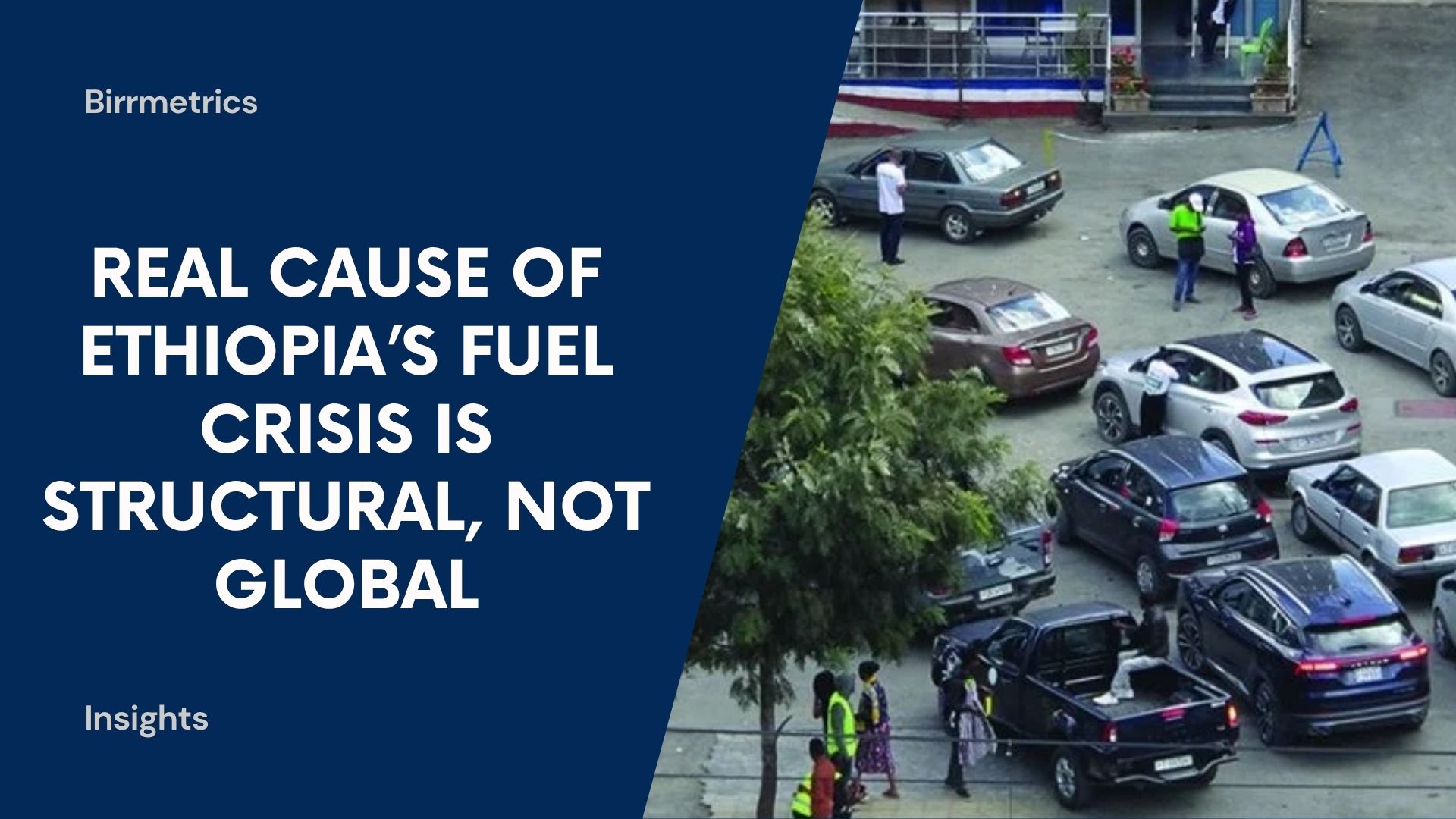
A war in the Gulf is already being paid for in Addis Ababa.
This is not because Ethiopia is directly involved in the conflict between Iran, Israel, and the United States, nor because it sits anywhere near the Strait of Hormuz. It is because, in today’s global economy, geography offers far less protection than policymakers often assume. Distance does not insulate; it merely obscures vulnerability.
Nearly one-fifth of the world’s traded oil passes through the Strait of Hormuz. When that chokepoint is disrupted, as it has been in the current escalation, the effects are immediate and global. Oil prices surge, insurance premiums spike, and tanker traffic slows. Brent crude approaching 120 dollars per barrel is not just a number; it is a transmission mechanism. For countries dependent on imported fuel, it is the beginning of a chain reaction.
Ethiopia sits at the far end of that chain.
The country imports virtually all of its petroleum. Every increase in global oil prices feeds directly into higher transport costs, rising food prices, and increased industrial input costs. A disruption in Hormuz does not remain in the Gulf; it appears in Addis Ababa as longer fuel queues, higher bus fares, and more expensive bread. The link is neither abstract nor delayed. It is immediate and material.
But the deeper problem is not oil dependency alone. It is the structure of the Ethiopian economy that amplifies external shocks.
Limited foreign exchange reserves mean that higher fuel import costs translate quickly into currency pressure. As demand for dollars rises, the birr weakens, making all imports more expensive. Banks, already constrained, tighten access to foreign currency, slowing industrial activity and reducing liquidity across the economy. What begins as an oil shock becomes a financial one.
At the same time, Ethiopia’s logistical architecture magnifies the impact. Reliance on a single import corridor through Djibouti and a predominantly road-based transport system creates bottlenecks that turn global disruptions into local crises. A delay at a distant port becomes a supply shortage inland. In such a system, even modest external shocks can produce disproportionate domestic consequences.
This is why the effects are nonlinear. A ten percent increase in global oil prices does not produce a ten percent increase in domestic costs. It produces cascading pressures: on transport, on food, on foreign exchange, and ultimately on inflation and living standards. The system does not absorb shocks; it amplifies them.
The industrial sector is particularly exposed. Many firms operate with thin margins and limited access to foreign currency. Rising fuel costs, supply chain disruptions, and financing constraints converge into a “perfect storm” that threatens output and employment. What has been described as a period of industrial expansion may prove more fragile than assumed, precisely because it has not been built with external volatility in mind.
Yet perhaps the most concerning aspect of the current moment is not the shock itself, but what it reveals.
For years, economic strategy has implicitly assumed that Ethiopia’s distance from major geopolitical flashpoints provides a degree of protection. That assumption is no longer tenable. In a world defined by tightly coupled supply chains and concentrated chokepoints, vulnerability is not determined by proximity, but by structure.
Dependence on imported fuel, concentrated trade routes, limited financial buffers, and narrow trade partnerships together create a system in which distant crises are quickly domesticated. The Gulf conflict does not need to reach Ethiopia physically to affect it profoundly. It already has.
This has clear implications for policy.
Energy diversification is not simply a long-term aspiration; it is a macroeconomic necessity. Investments in logistics, including alternative corridors and more efficient transport systems, are essential to reduce bottlenecks. Strengthening foreign exchange buffers and expanding trade partnerships can provide resilience against external shocks. Industrial policy must also evolve, placing greater emphasis on shock preparedness rather than baseline growth assumptions.
But these measures require more than technical adjustment. They require a shift in mindset.
The central challenge is not managing volatility, but recognising its permanence. External shocks are not exceptional events; they are a structural feature of the global economy. Planning as if stability will return is a mistake. The task is to build an economy that can function under persistent instability.
Ethiopia’s experience today offers a broader lesson. In an interconnected world, the idea that countries can remain insulated from distant conflicts is increasingly illusory. Economic systems are linked by what might be called invisible threads – flows of energy, finance, and trade that transmit shocks rapidly across borders.
For Ethiopia, those threads are not a source of resilience, but of exposure.
Until that changes, events in the Gulf will continue to shape outcomes in Addis Ababa. And the real risk is not that such shocks occur, but that they continue to reveal an uncomfortable truth: the country is far more vulnerable than it appears.
Mikiyas Mulugeta G. Yohannes (PhD) is an Independent consultant & Analyst. He can be reached at mikiusc2017@gmail.com.




