

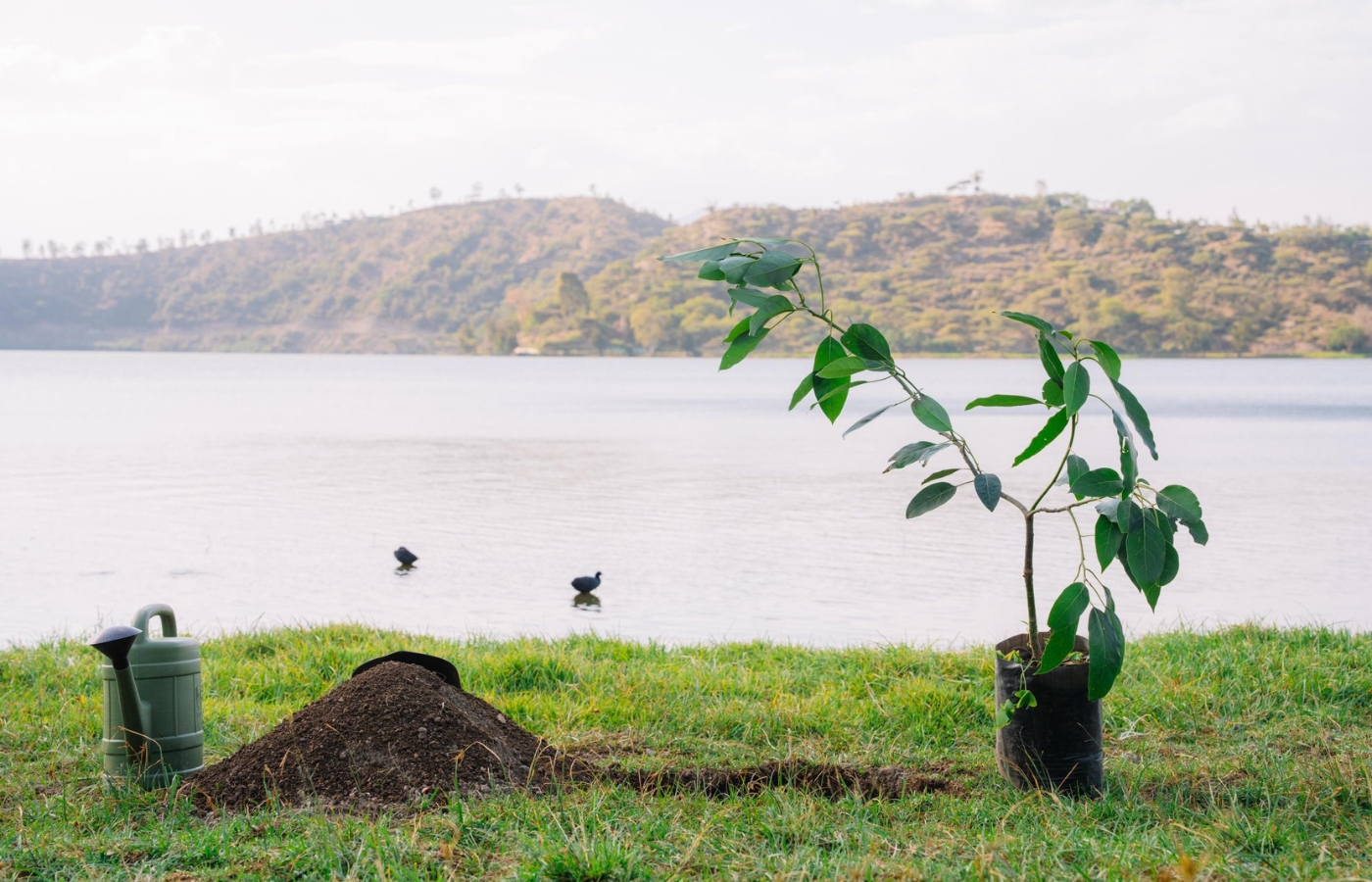
Almost two years after becoming the first country in the world to ban the import of gasoline and diesel vehicles, Ethiopia is widening its environmental push from roads to shops, markets and factories. On January 31, 2026, the government began enforcing a nationwide ban on the production, sale and use of single-use plastic bags, following a six-month transition period under its solid waste management law.
The measure is the latest sign of a country eager to present itself as a green-transition leader. Ethiopia has banned fuel-powered vehicle imports, promoted electric mobility, expanded tree-planting campaigns and folded climate goals into its Ten-Year Perspective Development Plan. But the harder test is no longer whether Ethiopia can announce climate policies. It is whether it can finance them.
That question is becoming more urgent as the country looks beyond grants and concessional loans toward green bonds and other sustainable finance instruments. Green bonds could help raise capital for renewable energy, electric mobility, climate-smart agriculture, reforestation, waste management, green industrial parks and resilient infrastructure. Yet they also require something Ethiopia’s young capital market is still trying to build: investor trust, credible rules, bankable projects and reliable verification.
Ethiopia’s climate ambition is substantial. In its third Nationally Determined Contribution, submitted to the UN Framework Convention on Climate Change, the country raised its greenhouse-gas emissions reduction target to 70.3 percent below a revised business-as-usual pathway by 2035, up from the previous 68.8 percent. Under its unconditional scenario, emissions are projected to fall from 201.9 MtCO₂e in 2025 to 140.8 MtCO₂e by 2035, a 40.7 percent reduction from business as usual. With international support, emissions could fall to 70.7 MtCO₂e, reaching the 70.3 percent target.
The scale of financing required is even larger. Ethiopia estimates that implementing its climate plan through 2035 will require hundreds of billions of US dollars across mitigation and adaptation, from renewable energy and low-carbon transport to climate-resilient agriculture and infrastructure. Recent climate-finance tracking shows how wide the gap remains: Ethiopia received an average of 2.3 billion US dollars in climate finance annually in 2022/23, while its NDC 3.0 implies annual needs of about 10.6 billion US dollars. More than 90 percent of tracked flows came from international public sources, while private climate finance accounted for less than five percent.
That imbalance explains why green bonds are attracting attention. Properly designed, they can turn climate plans into investable projects, allowing governments, banks or companies to raise money for activities with measurable environmental benefits. But in Ethiopia, the instrument is arriving before the full ecosystem is ready.
“There is virtually no support from regulators, despite clear demand from private businesses,” said Haile Mekonnen, Sustainability and ESG Division Manager at Wegagen Bank. “Without active backing, companies struggle to mobilise finance. Regulators may welcome innovative products, but ultimately the private sector must lead the charge.”
Haile said Ethiopia’s capital market opening has created interest in new financing tools, but not yet the advisory depth needed to structure them. Deciding which projects qualify, how much to raise, which sectors to prioritise, how to price risk and how to track impact remains largely uncharted territory.
“I don’t think issuing it to the public is realistic right now,” Haile told Birrmetrics. Public awareness of green bonds remains limited, he said, and even bank-led offerings could face resistance from boards unfamiliar with the instrument. Impact investors, in his view, may need to absorb a large share of early issuances to build confidence and create a demonstration effect.
A draft scoping study commissioned by FSD Ethiopia for the Ethiopian Capital Market Authority, in partnership with FSD Africa and the United Nations Development Programme, reaches a similar conclusion. It identifies thematic bonds, including green, social and sustainable bonds, sustainability-linked bonds and blue bonds, as among the most promising instruments for Ethiopia. But it also warns that the country’s nascent capital market has limited current capacity to support complex green financial products.
The study points to four linked constraints: fiscal pressure, credit-risk challenges, weak systems for tracking green activity and limited capital-market capability. It says Ethiopia’s climate-finance potential is real, but that the market still needs stronger infrastructure, clearer regulation and better data before green instruments can be scaled.
The absence of a national green taxonomy is one of the most important gaps. A green taxonomy is, in effect, a rulebook defining which projects qualify as environmentally sustainable. Without it, one issuer’s “green” project may be another investor’s doubtful claim. That creates room for inconsistent screening, weak disclosure and greenwashing, where environmental benefits are exaggerated to attract capital.
In Ethiopia, that risk is not abstract. A reforestation project could claim carbon benefits without credible survival-rate data. An electric transport project could be labelled green without assessing charging infrastructure, power sources or battery-waste management. A climate-smart agriculture project could promise resilience without measurable gains in water efficiency, yields or emissions reduction. For foreign investors and development-finance institutions, these details matter.
UNDP Ethiopia has already begun working on part of this problem. Through its support to the Enterprise Financing Facility, a proposed 100 million US dollars blended-finance vehicle for Ethiopian startups and SMEs, UNDP’s PISTA initiative is helping design a green screening and taxonomy framework, as well as social and environmental guidelines aligned with national regulations and UNDP standards.
That could eventually create a pipeline of investable green projects. The FSD Ethiopia scoping study identifies agriculture, forestry and land use, industry, power, water and transport as priority areas. Potential projects include climate-smart farm management, land restoration, greening industrial parks, renewable energy access, rural and urban water systems, electric bus rapid transit and wider e-mobility investments. Some of these projects require less than one million US dollars; others, particularly in transport and infrastructure, need more than 100 million US dollars and longer implementation periods.
For green bonds to work, however, Ethiopia needs more than project lists. It needs issuers with credible balance sheets, investors willing to buy, regulators able to supervise, verifiers trusted by the market and reporting systems that can prove where proceeds went.
That is where Ethiopia’s broader capital-market story becomes relevant. The Ethiopian Securities Exchange opened in January 2025, beginning with Wegagen Bank as its first listing. As of April 2026, the exchange lists Wegagen Bank, Gadaa Bank and Awash Bank, with Awash joining the main market on April 23, 2026.
The market is therefore young, thin and still forming its habits. Ethiopia has made progress by issuing investment-banking licences, establishing public-offer rules and building exchange infrastructure. But green bonds will test whether the market can move from basic equity listings toward more complex instruments requiring project-level disclosure, environmental reporting and continuous monitoring.
Investor trust is already a sensitive issue. Ethiopia’s first attempt to sell 10 percent of Ethio Telecom shares to the public raised 3.2 billion birr from 47,377 investors, after only 10.7 million of the 100 million shares offered were sold. The offer had initially aimed far higher, with reports placing the target at around 30 billion birr.
The lesson for green bonds is clear. A climate label will not compensate for weak confidence. Investors must believe that ownership records are secure, disclosures are reliable, proceeds are ring-fenced, environmental claims can be verified and issuers will be held accountable. In a market where retail investors are still learning how securities work, green bonds may need to begin with institutional and impact investors before moving toward broader public participation.
Mikias Mulugeta (PhD), an independent consultant who follows Ethiopia’s economy closely, said the country still struggles with transparency and accountability, particularly when new laws are enforced without clear communication.
“At the end of the day, trust is what matters most,” he said. International funders, he added, conduct rigorous due diligence, and one of their key measures is the credibility of the system. Macroeconomic stability, transparency and policy consistency all shape whether Ethiopia is seen as a trustworthy market.
He said private businesses also need to rethink long-standing practices. Many companies refer to the Sustainable Development Goals in strategy documents, he said, but fewer integrate them into operations, resource management or investment planning. For international funders, sustainability must be measurable, not decorative.
“The time to act is now,” he said, calling on companies to turn sustainability language into practical changes.
The warning is timely because Ethiopia is entering a crowded global market. Other African countries have already used green bonds to finance climate-related projects. Nigeria issued Africa’s first sovereign green bond in 2017, raising 10.69 billion naira for renewable energy and afforestation projects. Egypt followed in 2020 with a 750 million US dollars sovereign green bond, the first of its kind in the Middle East and North Africa. Kenya’s Acorn Holdings issued the country’s first corporate green bond in 2019, raising 4.3 billion Kenyan shillings to finance green-certified student housing.
These examples show that green bonds can work in emerging markets. But they also show what is required: a clear framework, credible certification, a project pipeline, investor education and, in many cases, development-finance support or credit enhancement.
Ethiopia’s case is more complicated because much of its mitigation potential rests on land use, forestry and agriculture. Its NDC 3.0 shows that land use, land-use change and forestry account for the largest share of planned mitigation by 2035. The document says forest cover has increased by 6.4 percent over the past six years to reach 23.6 percent, while land restoration and reforestation remain central to the country’s long-term mitigation pathway.
The government has also reported planting more than 40 billion seedlings under the Green Legacy campaign since 2019. But for investors, planting figures are only the starting point. Green finance requires evidence on survival rates, land tenure, biodiversity impact, carbon accounting and long-term monitoring. A bond backed by reforestation would need to prove not just that trees were planted, but that climate benefits are real, durable and independently verified.
Wondwesen Sisay (PhD), a climate policy expert, said reforestation can play a significant role in reducing emissions if properly implemented and monitored.
“Reforestation has the potential to sequester vast amounts of carbon dioxide and play a crucial role in reducing the country’s emissions,” he said, praising the government’s green initiatives.
But he said Ethiopia’s capital-intensive conditional NDC measures will require external climate finance. Two channels stand out: the Green Climate Fund and results-based mechanisms such as carbon credits. Ethiopia has already integrated carbon markets into its NDC 3.0, positioning them as a tool to mobilise climate finance and support low-emission development.
The Green Climate Fund remains one of the world’s largest multilateral climate funds, offering grants, loans and equity for low-emission and climate-resilient projects in developing countries. Ethiopia has also used the CRGE Facility, established by the Ministry of Finance and the environmental authorities in 2012, to channel climate finance for institutional support and implementation.
“This should be opened up to the private sector,” Haile said. “Many private players still lack awareness of the Green Climate Fund, both the opportunities it presents and the risks involved. Once that understanding is in place, they need to be encouraged to work together on developing bankable projects.”
Electric mobility offers another example of the gap between policy ambition and financing readiness. Ethiopia’s 2024 import ban on gasoline and diesel vehicles was bold, driven partly by the need to cut fuel imports and partly by the country’s green agenda. The number of electric vehicles has risen quickly, with estimates of more than 100,000 EVs on the road. But reports have also pointed to limited charging infrastructure, spare-part shortages, unreliable power supply and a shortage of trained mechanics.
That makes transport a promising but demanding green-bond sector. Bonds could finance public charging networks, electric buses, grid upgrades, battery-management systems, local assembly capacity and public transport electrification. But investors would need clear revenue models, credible operators and policy certainty. Without these, electric mobility remains a climate story, not yet a bankable investment story.
The same applies to the plastic-bag ban. It may reduce waste and create opportunities for alternative packaging, recycling and circular-economy businesses. But unless such firms can access finance, scale production and meet quality standards, the ban risks becoming another regulation whose environmental impact depends on enforcement and market response.
Haile said regulators must be rigorous when screening issuers, especially because green bonds involve public or institutional funds. Issuers must be able to show not only that a project is eligible, but also that money will be used as promised and environmental results will be reported over time.
That is where independent verification becomes decisive. For international investors, a green label will not be enough. They will want to know who certified the project, how the proceeds will be tracked, what environmental benefits are being claimed, and whether those claims can withstand scrutiny. Without credible second-party opinions, recognised certification and strong audit trails, Ethiopian green bonds could enter the market at a discount: priced higher, bought cautiously, or questioned before they mature.
The opening is there, but it is narrow. Climate finance is growing, though still far below Ethiopia’s needs. The capital market is young, but no longer theoretical. Development partners are present, but public money cannot carry the transition alone. Private investors, meanwhile, are unlikely to move on ambition; they will move on rules, returns and proof.
That makes timing critical. Ethiopia does not need to be first to market with a green bond. It needs to be credible when it gets there. A poorly prepared issuance would not simply fall short of its target. It could teach investors to approach the next one with suspicion, damaging confidence in both the capital market and the country’s climate-finance agenda.
A more prudent route would start with the basics: a clear taxonomy, a credible pipeline of projects, disclosure rules that leave little room for interpretation, advisers who understand the instrument, investors who understand the risks, and independent reviewers whose word carries weight beyond Ethiopia. Development-finance institutions or impact investors may also need to anchor the first issuance, not as a substitute for the market, but as a bridge toward it.
A first green bond from a trusted public financial institution, such as the Development Bank of Ethiopia, could help set the tone if it is backed by strong governance and transparent reporting. Done well, it could create a template for others. Done poorly, it could harden the very doubts the market is trying to overcome.
Ethiopia’s next test is therefore institutional. It must show that green projects can be clearly defined, properly financed, honestly monitored and independently verified. Until that happens, green bonds will remain an attractive idea waiting for the market infrastructure to make them believable.




