

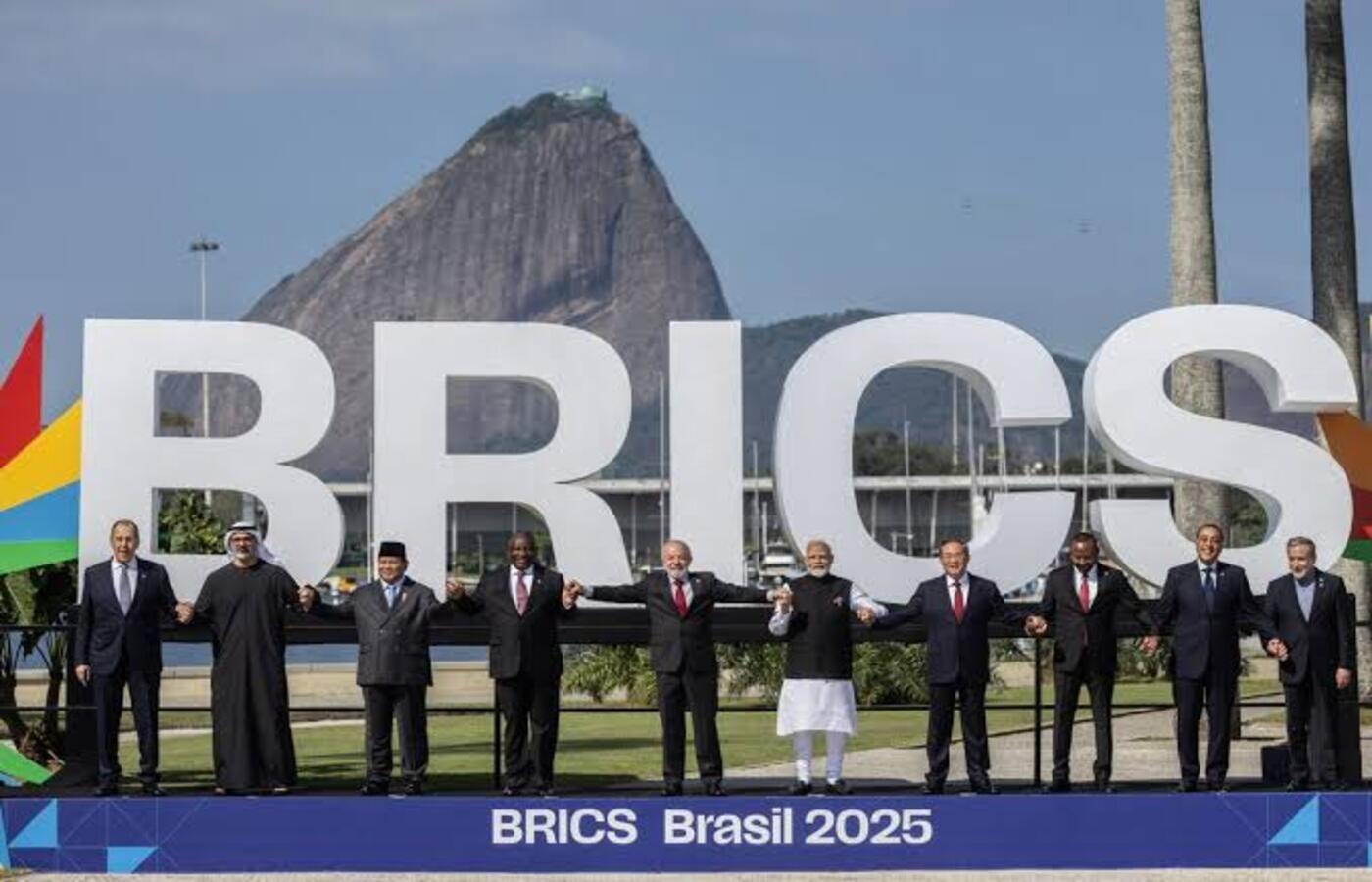
Former US president escalates rhetoric against emerging powers; PM Abiy urges overhaul of international institutions at Rio summit.
Donald Trump has threatened to impose an additional 10 percent tariff on any country aligning with the policies of the BRICS alliance, in a move that underscores growing geopolitical friction between the United States and an expanding bloc of emerging economies — including Ethiopia.
“Any country aligning themselves with the Anti-American policies of BRICS will be charged an ADDITIONAL 10 percent tariff. There will be no exceptions to this policy,” the US president posted on Truth Social on Sunday.
The remarks follow a weekend summit of BRICS leaders in Rio de Janeiro, where the group not only reaffirmed its ambition to reshape global governance but also expanded its network. Indonesia was formally welcomed as a new member, while ten additional countries — Belarus, Bolivia, Kazakhstan, Nigeria, Malaysia, Thailand, Cuba, Vietnam, Uganda, and Uzbekistan — were recognised as BRICS partner nations. The latest expansion reflects the bloc’s growing appeal as an alternative platform for global diplomacy and economic cooperation.
BRICS, which initially included Brazil, Russia, India, China, and South Africa, had already broadened its membership in 2023 to include Ethiopia, Egypt, Iran, Saudi Arabia, and the United Arab Emirates. The group now represents more than half the world’s population and an increasing share of global GDP — a demographic and economic weight that gives renewed urgency to its calls for a multipolar world order.
Ethiopia, attending its first in-person summit as a full member, used the platform to press for reforms in global governance. During the summit’s opening session on peace, security and global governance, Prime Minister Abiy Ahmed urged the transformation of international institutions to better reflect the interests of developing nations.
“BRICS has grown from a bold idea into a dynamic force for global transformation,” said Abiy. “With the addition of new members, our collective voice grows stronger, our shared purpose becomes clearer, and our potential expands.”
According to a statement from the Office of the Prime Minister, Abiy’s remarks highlighted the need for “international institutions that can foster mutual trust and enable effective cooperation,” and reiterated Ethiopia’s support for reforms to the decision-making structures of global financial institutions, including the International Monetary Fund.
The joint communiqué issued by BRICS finance ministers described tariffs — a veiled criticism of US trade policy — as a threat to the global economy, warning they introduce “uncertainty into international economic and trade activities.” The statement also condemned recent military strikes on Iran, including those by Israel and the United States, as violations of international law.
US President Trump has long regarded BRICS as a strategic rival. He previously threatened 100 percent tariffs on the bloc’s members if they pursued plans for a joint currency to rival the US dollar.
The Rio summit was attended by Indian prime minister Narendra Modi, South African president Cyril Ramaphosa, and other world leaders. Chinese president Xi Jinping was absent for the first time, with premier Li Qiang representing Beijing. Russian president Vladimir Putin participated via video link.




