

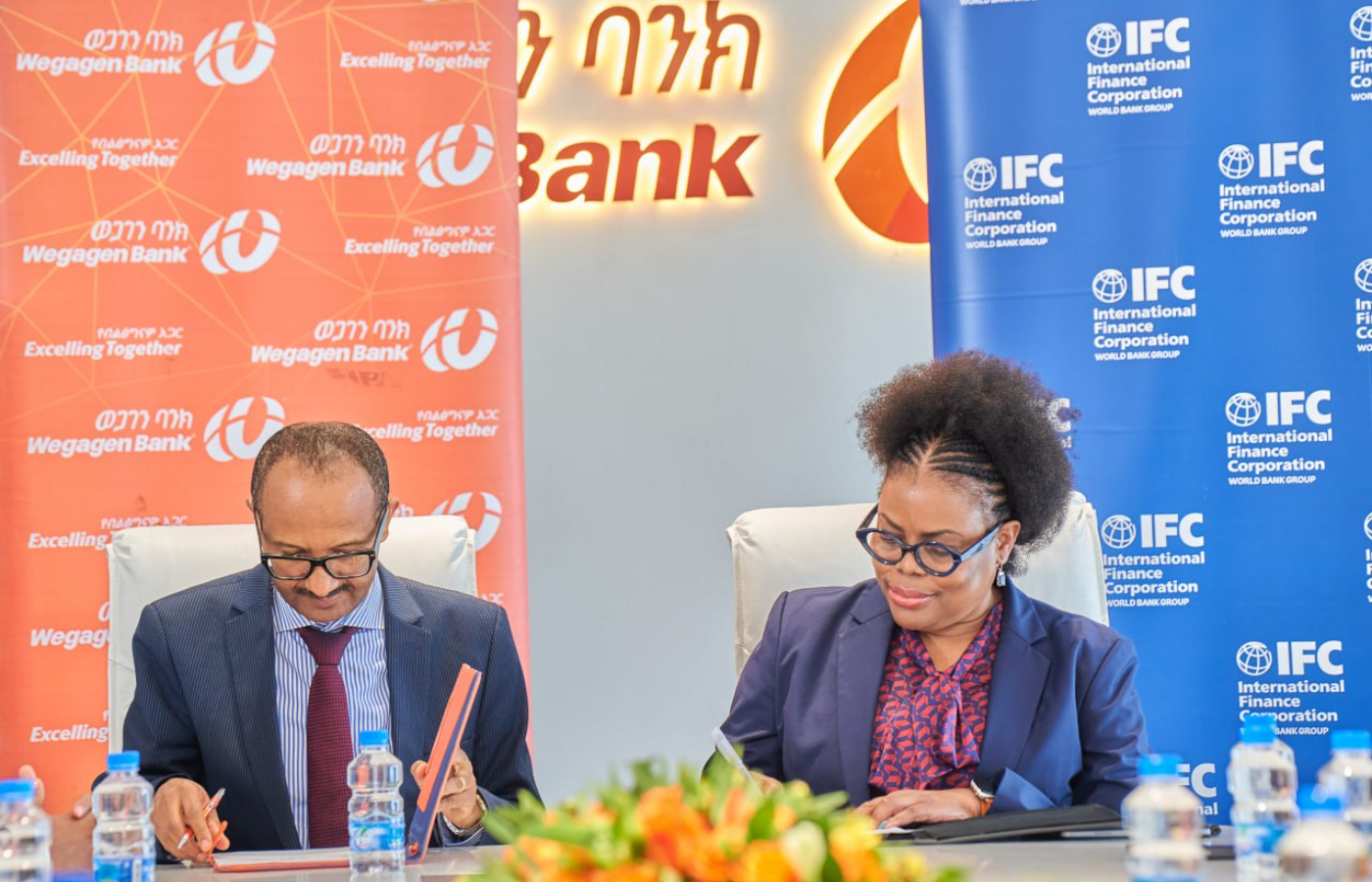
Wegagen Bank has secured a 10 million US dollar trade finance guarantee from the International Finance Corporation, in a move designed to ease constraints in financing cross-border trade as Ethiopian businesses grapple with foreign currency shortages and tight external credit conditions.
The facility, signed in Addis Ababa on Thursday, places Wegagen Bank under IFC’s Global Trade Finance Program, a long-running international platform that provides guarantees to reduce payment risk in cross-border transactions and connect banks in emerging markets with global financial institutions.
At its core, the instrument works as a risk bridge. By backing trade transactions, IFC enables local banks to issue letters of credit and other trade instruments with reduced counterparty exposure, effectively reopening channels for importers and exporters that often struggle to access international banking networks.
The intervention comes amid ongoing constraints in Ethiopia’s trade financing environment, where foreign currency availability and correspondent banking relationships continue to influence the capacity of local banks to support import and export activity. These conditions have contributed to a gap between demand for trade finance and available credit, particularly for small and medium-sized enterprises.
Speaking at the signing ceremony, Wegagen Bank Chief Executive Officer Aklilu Wubet (PhD) described the agreement as a milestone for the institution.
“The strategic partnership agreement with IFC represents a significant milestone for the Bank and will enhance its ability to better serve customers,” he said, adding that the bank intends to deepen cooperation with IFC in areas linked to financial inclusion and broader economic development.
IFC Country Manager for Ethiopia, Malawi and Zambia, Madalo Minofu, said the partnership reflects a broader effort to expand access to trade finance in Ethiopia’s private sector.
She noted that many businesses, particularly small and medium-sized enterprises, continue to face constraints in financing cross-border trade. The facility, she said, would help firms access inputs, meet demand, and integrate more effectively into regional and global markets, while accompanying advisory support would strengthen risk management and treasury operations within the bank.
IFC’s Global Trade Finance Program operates across a network of financial institutions in emerging markets and is used to support cross-border transactions where risk perception limits direct engagement between international and local banks.
In Ethiopia, where imports of machinery, fuel and industrial inputs remain central to economic activity while exports are concentrated in a narrow set of commodities, the imbalance places additional pressure on foreign exchange availability. This, in turn, limits the ability of businesses, particularly small and medium-sized enterprises, to secure reliable trade credit despite strong underlying demand.
Alongside the guarantee facility, IFC is also providing advisory support to Wegagen Bank aimed at strengthening internal systems in risk management, treasury operations and trade finance, aligning them more closely with international standards.
Wegagen Bank, one of Ethiopia’s larger private lenders with more than 460 branches nationwide, has been expanding its footprint beyond traditional banking through digital lending platforms and capital market participation. Its recent listing on Ethiopia’s securities exchange marked a broader shift toward formalised private sector capital formation.




