

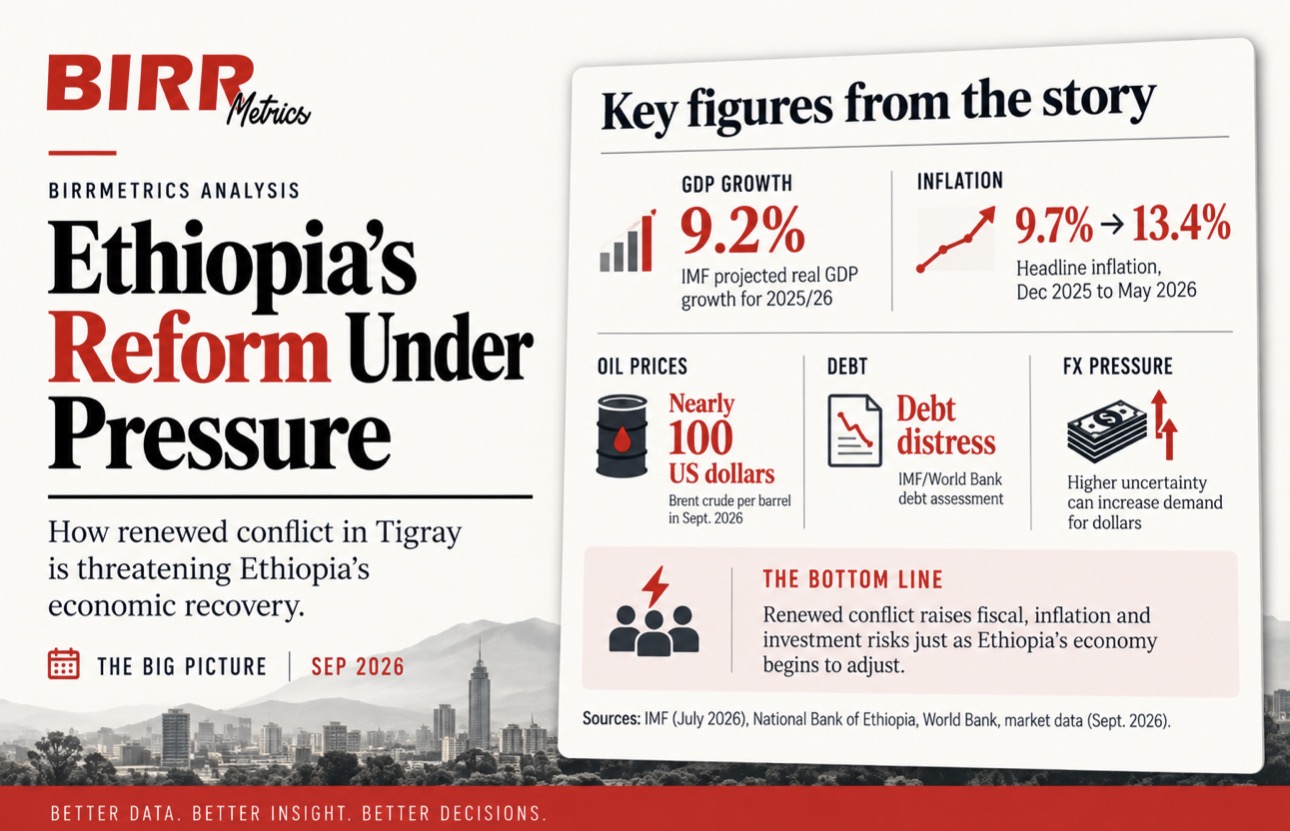
Ethiopia enters the latest northern security crisis with larger foreign-exchange reserves, stronger exports and an IMF-backed reform programme. It also enters it with a 2.34 trillion birr budget, ambitious tax targets, unfinished debt restructuring and little room for another expensive shock.
The first casualty of war is rarely recorded in a government budget.
It appears first as a cancelled flight. A truck that no longer takes a particular road. A hotel booking abandoned. An investor who postpones signing. A business that begins holding dollars rather than birr. A government procurement order suddenly marked urgent.
Then the numbers start appearing.
On September 23, Ethiopian Airlines suspended flights to Mekelle, Axum and Shire after Tigrayan forces took control of Mekelle airport from federal police. The shutdown followed months of deteriorating relations between the federal government and the Tigray People’s Liberation Front and came three days after the TPLF and six other armed groups announced a new alliance opposed to the federal government.
Those developments do not mean Ethiopia has returned to a war on the scale of 2020–2022.
They do, however, make the economic question unavoidable.
What would another northern war cost Ethiopia?
The answer is substantially more complicated than counting military expenditure.
Another prolonged conflict would collide with almost every pillar of Ethiopia’s current macroeconomic programme: the floating exchange-rate regime, tax mobilisation, reserve accumulation, fiscal consolidation, debt restructuring, private investment, export expansion and the gradual shift from state-directed financing toward a more market-based financial system.
And Ethiopia already knows the bill from the last war.
The World Bank’s Ethiopia Damage and Needs Assessment estimated that economic losses associated with the previous conflict amounted to about 5.5 percent of national GDP in 2020/21, while damage to infrastructure and property between November 2020 and December 2021 alone was equivalent to 20.4 percent of GDP.
Reconstruction and recovery requirements were subsequently estimated at close to 20 billion US dollars. Much of that reconstruction remains unfinished. A second large conflict would therefore not begin from zero. It would begin on top of the first war’s unpaid bill.
The First Visible Economic Rupture: Connectivity
For now, the most tangible economic consequence of the renewed confrontation is aviation.
Ethiopian Airlines has stopped scheduled flights to Mekelle, Axum and Shire. No other commercial airline normally provides regular scheduled services to the region.
The direct loss to Ethiopian Airlines itself is likely manageable if the suspension is brief.
The significance lies elsewhere.
Air transport is a basic economic connection between Tigray and the rest of Ethiopia.
Its interruption affects business travellers, traders, consultants, government employees, NGOs, tourism operators and families moving between the region and Addis Ababa.
Axum in particular is one of Ethiopia’s most important heritage tourism destinations.
The longer the suspension persists, the more economic activity moves from being delayed to being cancelled.
Land transport is the second vulnerability.
During Ethiopia’s previous conflict, transport disruptions extended far beyond battle lines. Firms located outside conflict areas also suffered through disrupted buyer and supplier relationships with businesses inside them.
The Ethiopia-Sudan trade corridor was particularly affected.
The Metema-Gallabat crossing was intermittently closed for almost two years between late 2020 and 2022, increasing transport costs and reducing formal commercial activity.
That experience matters because wars transmit economically through networks. A factory does not have to be bombed to suffer from war. It merely needs its supplier to become inaccessible.
The Birr: No Panic Yet
One of the most important things to say about the present crisis is also one of the easiest things to exaggerate:
The exchange rate has not, so far, shown evidence of a war-driven collapse.
Around the announcement of the new armed alliance on September 21, the National Bank of Ethiopia’s indicative rate was approximately 160.88 birr per US dollar.
On September 25, it stood around 160.79 birr per US dollar.
Commercial-bank selling rates were generally clustered around 163 birr to 165 birr per US dollar.
Four days are not enough to establish a trend, and Ethiopia’s foreign-exchange market is still not comparable with a fully liquid freely traded currency market.
But the distinction is important:
Security risk has increased. An FX crisis has not yet followed. The bigger question is what would happen if the confrontation became prolonged. Ethiopia today operates a market-based exchange-rate regime introduced as part of the July 2024 reform package.
Maintaining confidence in that regime depends partly on the country’s ability to keep supplying foreign currency to the market.
Here Ethiopia possesses a buffer it did not have during the previous war. Gross international reserves increased from approximately 1.4 billion US dollars, or 0.7 months of prospective imports, at the end of 2023/24 to 4.4 billion US dollars, or 1.9 months, at the end of 2024/25.
The IMF projected reserves reaching approximately 5.6 billion US dollars, equivalent to 2.2 months of imports, in 2025/26. That is a considerable improvement. It is not an unlimited defence.
A prolonged conflict could pressure the FX market through at least six channels.
Higher government demand for foreign currency. Military equipment, spare parts, fuel and other imported supplies increase hard-currency requirements.
Household and business precautionary demand for dollars. The result need not be an immediate currency crash. A more plausible early signal would be persistent excess demand for dollars, widening differences between formal and informal markets, larger bank spreads, increased import costs and a faster pace of nominal depreciation.
The Lesson From 2020: The Birr Weakened as the War Deepened
Historical exchange-rate data provide useful context. The average official rate moved from approximately:
| Year | Birr per US dollar |
| 2019 | 29.07 |
| 2020 | 34.93 |
| 2021 | 43.73 |
| 2022 | 51.76 |
| 2023 | 54.35 |
The birr depreciated by around 18 percent in 2020, 22 percent in 2021 and another 17 percent in 2022 on this measure.
Not all of that depreciation was caused by the war.
Ethiopia was simultaneously dealing with COVID-19, high inflation, structural foreign-exchange shortages, drought, global commodity shocks and a managed exchange-rate system that was already allowing gradual depreciation.
But the war intensified several of those pressures simultaneously.
The conflict worsened Ethiopia’s macroeconomic imbalances, aggravated inflation through supply disruptions and speculation, reduced external assistance and loans and intensified balance-of-payments pressure.
That transmission mechanism remains relevant today.
The 2.34 Trillion Birr Question
The greatest immediate vulnerability may be fiscal rather than monetary.
Ethiopia’s federal budget for 2026/27 is approximately 2.339 trillion birr, roughly 21 percent larger than the preceding year’s approved budget.
The government entered the year planning to reduce its deficit, not finance another war.
The IMF programme envisages the overall deficit excluding grants falling from around 3.3 percent of GDP to 2.1 percent under the relevant federal budget measure, while the broader general-government deficit is projected around 1.4 percent of GDP.
That consolidation is not automatic. It relies on a set of assumptions. Tax collections rise. Subsidies become better targeted. Domestic financing remains manageable. External financing continues. Capital expenditure follows the agreed framework. And major unforeseen expenditure does not overwhelm the budget.
War attacks every one of those assumptions. The first impact is obvious: security expenditure rises. During the previous war, military expenditure absorbed a considerably larger portion of public spending.
Ethiopia’s fiscal deficit reached 4.2 percent of GDP in 2021/22, before falling as defence expenditure declined and fiscal adjustment resumed. That is the historical warning.
A prolonged war would present the government with three basic options: increase the deficit;cut or postpone non-security spending; or raise additional revenue or financing.
In practice, governments at war often combine all three.
Road projects can wait. Hospital procurement can be reduced. Capital programmes can be postponed. Transfers can be squeezed. But soldiers, fuel and military logistics usually cannot.
The economic cost goes well beyond the defence line in the budget. It includes the public investment that never happens. The timing is particularly difficult because the 2026/27 budget was prepared after another major external shock.
The Middle East war had already pushed fuel and fertilizer prices higher by the time the budget was designed. Ethiopia subsequently requested that the IMF bring forward about 200 million US dollars of financing specifically to help absorb those pressures.
The government also committed large resources to restructuring the finances of Ethiopian Petroleum Supply Enterprise. A total 286 billion birr recapitalisation was approved, with about 170 billion birr expected from World Bank resources and another 116 billion birr from the 2026/27 budget.
The fiscal system already contains a major commodity-price shock. Another domestic security shock would arrive on top of it. That layering matters. Macroeconomic shocks are not additive in a simple arithmetic sense. They reinforce one another. Higher security expenditure can weaken the fiscal position. A weaker fiscal position can raise borrowing. Higher borrowing can increase interest costs. FX pressure can raise the birr cost of imported fuel and fertilizer. Those costs can then require additional fiscal support. A negative loop becomes possible.
The IMF programme assumes a sharp improvement in revenue mobilisation. Federal tax revenue is targeted at around 1.296 trillion birr by June 2027 under the programme’s quantitative framework.
The broader projection puts general-government tax revenue substantially higher as regional collections are included. Conflict attacks tax revenue from several directions. Businesses in affected areas stop operating.
Transport disruptions reduce turnover. Import volumes can weaken. Investment projects are postponed. Corporate profits fall. Employment shrinks. And enforcement becomes more difficult. For Ethiopia, one particular line matters enormously: taxes on imports.
Around 785 billion birr in import duties and taxes is projected for 2026/27 at the general-government level. A severe reduction in commercial imports would create a paradox.
It could ease demand for foreign currency while simultaneously cutting one of the government’s most important tax streams. War can improve a trade deficit for all the wrong reasons.
Trade: Ethiopia’s Vulnerability Is Not Tigray’s Export Volume
One analytical mistake would be to measure the economic danger by asking what percentage of Ethiopia’s exports originate in Tigray.
That misses the larger issue. The country’s principal external trade route runs through Djibouti, not Tigray.
The real national trade risk would arise if conflict widened into Afar, Amhara or the Ethiopia-Eritrea frontier in a way that disrupted transport arteries or raised insurance and logistics costs.
The previous war provides a precedent.
When Tigrayan forces advanced into Afar in 2021, one strategic concern was their proximity to the transport corridor connecting Ethiopia to Djibouti.
Even without physical closure, perceived corridor risk matters. Freight operators price, insurers, drivers and warehouses price security. And importers increase inventory when they fear disruption. All of those eventually appear in consumer prices.
The country’s external accounts have recently improved dramatically.
The current-account deficit narrowed from 2.9 percent of GDP in 2023/24 to 1.1 percent in 2024/25, helped by strong export performance. It was expected to widen again as imports recovered under improved FX availability.
For 2026/27, projections indicate: goods exports around 6.7 percent of GDP; goods imports around 16.1 percent; a trade deficit around 9.5 percent; and a current-account deficit around 2.3 percent.
Those are manageable projections only if foreign-currency inflows behave broadly as expected.
A war scenario changes the composition.
Exports may weaken. FDI may slow. Tourism receipts can fall. At the same time, government-related FX demand can increase. The balance-of-payments problem becomes less about the trade deficit alone and more about how the deficit is financed.
Foreign Investment: The Cost Begins Before Investors Leave
Foreign investment rarely reacts to conflict in a single dramatic announcement. There is usually no press conference saying: “We have decided not to invest.”
A board postpones a decision. A due-diligence visit is delayed. A risk committee asks for another assessment. An insurer increases its premium. A lender shortens maturity.
A company that intended to deploy 100 million US dollars deploys 30 million US dollars first. None necessarily appears immediately in headline FDI statistics. But collectively they matter.
FDI equivalent to roughly 3 percent of GDP is projected over the medium term. That projection sits at the centre of Ethiopia’s attempt to change its growth model.
Banking is opening. Retail and wholesale sectors have been liberalised further. The capital market is developing. The government wants more private capital and less state-led allocation of finance. War pushes the economy in precisely the opposite direction.
Investors demand more protection. Banks become cautious. Government borrowing expands. And private-sector credit risks being crowded out.
The Interest-Rate Problem
This is where another war could collide with one of Ethiopia’s least discussed reforms. The country is gradually moving away from financially repressed government borrowing toward a more market-based domestic debt market.
That means government borrowing increasingly has a price.Domestic debt-service costs are already expected to rise as Ethiopia develops its domestic securities market.
If security expenditure forced the Treasury to issue substantially more bills and bonds, three effects could follow. Government financing costs could increase.
Banks could hold more government securities. And credit that might otherwise have gone to businesses could instead finance the Treasury.
That is the classic crowding-out channel.
In Ethiopia it would arrive at exactly the moment authorities are attempting to expand private-sector-led growth.
Another northern war would not necessarily produce inflation simply because the government spent more money.
The first effect would likely come through supply.
Road disruptions. Higher transport charges. Inventory shortages. Imported input costs. Precautionary stockpiling. FX pressure. Fuel logistics.
The previous conflict demonstrates the mechanism. The war amplified inflation through supply-chain disruption and expectations of future inflation. This time Ethiopia starts with inflation already significantly lower than in the early reform period.
But it is not eliminated.
Headline inflation rose from 11.7 percent in April to 13.4 percent in May 2026 following external commodity pressures. Renewed domestic supply disruption could make the National Bank of Ethiopia’s job harder.
The central bank might then face the uncomfortable combination of weaker growth and stronger inflationary pressure. That is a much harder problem than inflation created by excess demand alone.
The Donor Question
The previous war also demonstrated that conflict can change Ethiopia’s financing relationship with international partners.
In December 2020, the European Union deferred 88 million euros in direct budget support, citing humanitarian-access concerns.
The World Bank subsequently paused approvals of most new lending in late 2021 while it conducted additional risk assessments, although existing and emergency operations continued.
The United States removed Ethiopia from AGOA trade preferences from January 1, 2022, citing statutory eligibility concerns related in part to the conflict and human-rights situation.
The commercial consequences were significant for industrial parks.
Before suspension, around 70 percent of Ethiopian textile and garment exports were destined for the United States, and at least 56,000 industrial-park jobs were estimated to be exposed to the loss of AGOA preferences.
There is no basis today to assume automatically that exactly the same measures would recur.
But the lesson is important:
The external cost of conflict can be larger than battlefield expenditure.
A deterioration in relations with donors or trading partners changes grants, concessional financing, investment and export-market access simultaneously.
Debt Restructuring May Be the Quiet Vulnerability
Ethiopia is still restructuring external debt.
The government defaulted on a 33 million US dollars Eurobond coupon in December 2023 and subsequently entered negotiations with official and commercial creditors.
By June 2026, seven of 14 official creditor committee members had signed bilateral agreements, while agreements in principle had been reached with additional commercial creditors.
Negotiations with Eurobond holders were still continuing. Another major conflict would not automatically derail restructuring.
But debt agreements depend heavily on assumptions about future fiscal capacity, exports, growth and debt sustainability.
A prolonged war could weaken each of them. It could also change what creditors believe Ethiopia is capable of paying. The government would consequently be negotiating yesterday’s debt while financing today’s war.
Perhaps the largest cost is harder to quantify. Ethiopia spent much of the period after the Pretoria agreement rebuilding relationships with international financial institutions and restarting reforms that had stalled during the previous conflict.
The original reform programme launched before the Tigray conflict was disrupted by the combination of war and the pandemic. Earlier IMF arrangements expired without completing reviews and with limited progress on intended macroeconomic reforms.
The present reform programme is much further advanced. A market-based exchange rate has been introduced.
Foreign-exchange restrictions have been reduced. Domestic revenue has risen. Foreign reserves have increased. A new monetary framework is developing.
Private-sector credit is intended to play a larger role. State-owned enterprise liabilities are being addressed.
Debt restructuring has progressed. By July 2026, total disbursements under the current IMF ECF programme had reached around 2.65 billion US dollars.
War would not erase those reforms overnight. But it could change government priorities from reform to crisis management. That is exactly what happened once before.
There is no single credible figure representing the total economic cost of the 2020–2022 war. Anyone offering one precise number should be treated carefully.
Different estimates measure different things. The strongest benchmarks are these: 5.5 percent of GDP: estimated economic losses in 2020/21.
20.4 percent of GDP: estimated physical damage to property and infrastructure between November 2020 and December 2021.
Around 20 billion US dollars: estimated reconstruction and recovery requirement.
4.2 percent of GDP: fiscal deficit in 2021/22 before subsequently declining as defence expenditure fell.
88 million euros: EU budget support deferred early in the conflict.
Those figures still fail to capture lost investment, interrupted education, foregone tourism, destroyed business relationships, human-capital losses or the return investors required for accepting Ethiopian risk. The true cost was larger than the reconstruction invoice.
There is an important counterargument. Ethiopia’s economy in September 2026 is not the economy of November 2020.
Its reserves are larger. Exports are stronger. The FX system is more flexible. Tax collection has improved. An IMF programme is active. International financing relationships have been rebuilt.
The economy has also become accustomed to operating under considerable political and security stress. Those buffers matter. They mean renewed localised fighting does not automatically imply a macroeconomic crisis.
But they also explain what is at stake. The reforms have created assets that can now be lost. Reserve accumulation can reverse. Fiscal consolidation can reverse. Inflation can accelerate again. Investment can pause. Domestic borrowing can expand. Foreign-exchange reform can come under political pressure.
Development spending can be displaced by security expenditure.
And another reconstruction bill can begin accumulating before the previous one has been paid.
Three Economic Scenarios
The distinction between escalation and prolonged war is crucial.
1. Contained Confrontation
Flights eventually resume, major highways remain open, fighting remains geographically limited and the political dispute moves back toward negotiation.
Under this scenario, the national macroeconomic effect could remain modest.
Tourism and investment sentiment would suffer temporarily, northern commerce would lose activity and security expenditure could rise, but the IMF programme and federal budget could remain broadly intact.
2. Sustained Northern War
Fighting persists for months and involves larger forces across Tigray and neighbouring areas.
This would materially raise defence spending, disrupt regional commerce, weaken investment, increase humanitarian costs and place additional pressure on FX reserves and inflation.
The government’s 1.4 percent-of-GDP general-government deficit projection would become considerably harder to achieve.
Capital expenditure would be particularly vulnerable.
3. Regionalised Conflict
The most economically damaging scenario would involve conflict affecting Eritrea or disrupting transport routes through Afar toward Djibouti.
This would cease to be primarily a Tigray economic shock.
It would become a national external-sector shock.
Transport insurance, fuel imports, freight costs, foreign reserves, exports, investor confidence, aviation and government finances could all be affected simultaneously.
That is the scenario in which the economic cost would potentially become nonlinear.
Ten Numbers to Watch Now
The next phase of the story will not be told only from the battlefield.
It will appear in economic data.
The economics of another northern war would ultimately be determined by duration and geography. A week of confrontation is an interruption. Months of fighting become a fiscal event.
A war touching Ethiopia’s main international trade arteries becomes a balance-of-payments event. And a prolonged confrontation that changes relations with donors, investors and creditors becomes something larger still: a threat to the economic restructuring Ethiopia has spent the last two years trying to rebuild.
The first war left roughly 20 billion US dollars in reconstruction needs. The more consequential question now is not whether Ethiopia could finance another war.
Governments almost always find ways to finance wars. It is what else Ethiopia would stop financing in order to do so.




