

How Ethiopia Celebrated Fasika Under the Weight of Rising Prices
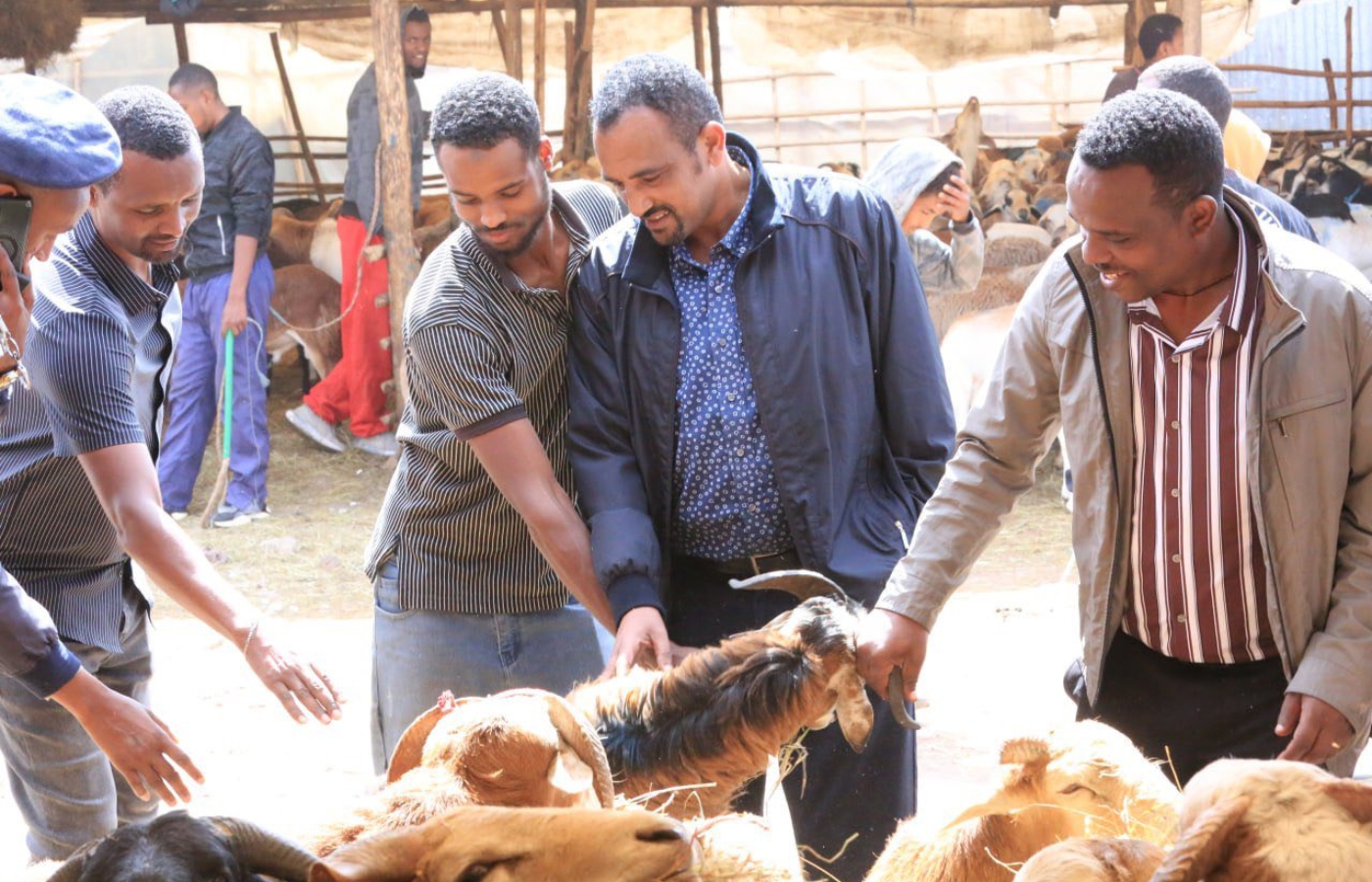
By the time the long fast ended and Fasika arrived on 12 April 2026, Addis Ababa’s holiday markets were already buzzing. Around Addisu Gebeya, in the livestock yards of Bere Tera, and along the crowded stretches near Shola, the city looked ready for celebration. Sheep and goats jostled in holding pens. Chickens were lined up for sale. Onion stacks sat high on market boards. Shoppers moved with the urgency familiar to every Ethiopian holiday, balancing cash, custom and compromise.
There was, by most accounts, enough to buy.
The harder question was who could still afford it.
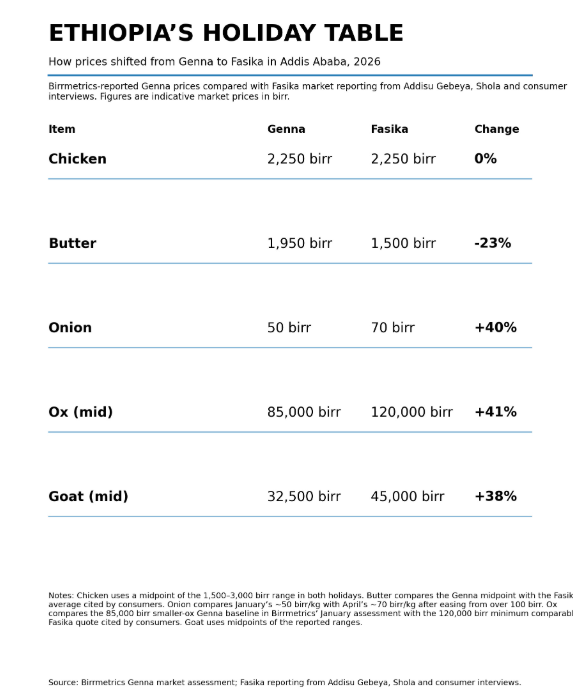
For Tibebu Mezgebe, a father of one, the Easter season came down to numbers. A mulu kircha cost him 15,000 birr. Kibe, indispensable to the Easter table, averaged about 1,500 birr. Onion prices, which had climbed to over 100 birr a kilo last week, eased to about 70 birr, but still sat well above what many households consider comfortable. A single doro was selling for between 1,500 and 3,000 birr, depending on size.
Those figures do not sit in isolation. They come only three months after Genna, when a Birrmetrics market assessment by staff journalists found that holiday prices had already moved sharply against consumers. In that January assessment, chicken was selling for 1,500 to 3,000 birr, butter ranged from 1,700 to 2,200 birr per kilogram, eggs were 25 to 27 birr each, and onions hovered around 50 birr a kilo.
Large goats were about 55,000 birr, medium goats 30,000 to 35,000 birr, while large oxen were trading near 200,000 birr and smaller ones around 85,000 birr. Easter, then, did not bring a fresh rupture so much as confirm a grim trend: the holiday table has become steadily more expensive, and the inflation families felt at Genna has not meaningfully loosened its grip.
If anything, for some goods, the pressure has hardened.
A consumer, Medfu Tadesse, a father in the Riche area, described what happened to his family’s regular kircha arrangement. It is a long-running contribution system, one of the quiet ways Ethiopians adapt collective celebration to economic strain.
This year, he said, the contribution had to be adjusted upward because the market had shifted so dramatically. The group had bought an ox during the Christmas holiday for 80,000 birr, assuming Easter would be in the same range. Instead, he found that the minimum price for a comparable animal had jumped to around 120,000 birr.
That jump tells its own story.
In the markets around Addisu Gebeya, consumers and traders said this year’s Easter season was notable for one reason: there was no serious shortage of holiday goods. Supply was visibly stronger than many had feared. Livestock was available in abundance. Onions, eggs and spices were flowing. The problem was not absence. It was access.
Goats were selling for 30,000 to 60,000 birr. A medium-sized ox could fetch up to 90,000 birr, while better-fattened animals were quoted much higher. Sheep were trading between 15,000 and 40,000 birr. One buyer, Solomon Arega, who bought an ox for communal sharing, said the animal he purchased for 80,000 birr was noticeably smaller than what the same amount would once have secured. The market, he suggested, no longer rewards ordinary buyers with proportional value.
That complaint echoed elsewhere. In Shola, another small market just three kilometeres away from Piassa, shoppers said supply had improved, but only within a market that still felt punishing. Eggs were selling for around 20 birr each. Onions were priced between 50 and 80 birr a kilo. Chickens were going for 1,500 to 2,000 birr.
One customer, Alemash Worku, said she had bought early to avoid any disruption and paid what she described as the city administration’s ceiling price for onions. Chicken, she said, was broadly comparable to previous holidays. But that offered little comfort. The wider basket — spices, butter, meat, oil — was still well beyond what her salary could comfortably absorb.
She is hardly alone. Ethiopia entered Easter under a fresh layer of pressure triggered by the Gulf crisis and the resulting disruption to oil supply routes. In late March and early April, the country faced visible fuel shortages, prompting official fuel-saving measures and concerns over the transport of goods into Addis Ababa.
State institutions and companies were instructed to reduce fuel use and shift activity online where possible, as Ethiopia tried to manage supply fears linked to regional turmoil. The Associated Press, reporting from Addis Ababa during the Easter period, described fuel stations running dry, long queues forming across the city, and consumers already connecting holiday price spikes to rising transport costs.
Then came the price adjustment. The government raised the price of white diesel by 16.6 percent effective 1 April 2026, taking it to 163.09 birr per litre from 139.84 birr. That was not an abstract policy change. Diesel runs the routes that bring oxen, sheep, chickens and onions from producing areas to urban markets. When fuel costs rise suddenly — and when supply itself is unreliable — the cost is transmitted through nearly every holiday item on sale.
That is the missing bridge between the Gulf and the kitchen.
Livestock traders had already been saying at Genna that transport was becoming one of the largest cost drivers in the market. By Easter, that pressure had become even harder to ignore. Animals do not price themselves only by size or demand; they arrive carrying the costs of fuel, trucking, route insecurity and delays. So do onions. So does butter. So do spices. In a fragile market, a geopolitical shock thousands of kilometres away can end up measured in the cost of a rooster in Addis.
The paradox is that this happened even as national inflation data suggested some moderation. Ethiopia’s annual inflation rate eased to 9.4 percent in March 2026, according to Trading Economics, the lowest level in years. But that headline masked the sharper pain still visible in food. Food inflation stood at 11 percent, with meat and vegetables among the categories still rising. So while the macroeconomic picture appears calmer than in earlier years, the lived experience of the holiday shopper remains stubbornly harsh.
That gap — between official disinflation and the actual price of celebration — is where many Ethiopian families now live.
For Wesen Desta, the price of goats and sheep has become a source of real frustration. He said goat prices had risen enough to upend an older family practice: he used to buy one for the holiday; now he cannot. Spice prices, he said, have become so burdensome that they swallowed up to 20,000 birr of spending. The complaint sounds personal, but it also captures the wider shift in Ethiopia’s festive economy. Traditions survive, but at a smaller scale. The feast is preserved, but edited. The obligation to celebrate remains, even when the budget no longer does.
And that may be the defining feature of Easter 2026.
This was not a holiday overshadowed by empty markets. It was one overshadowed by calculation. Families compared prices not with some distant past, but with Genna only a few months earlier. They remembered the ox they bought in January and found it costlier now. They saw onions fall from last week’s peak, but not enough to feel cheap. They found that even where supply had improved, affordability had not returned.
The Birrmetrics journalists’ holiday assessments — first at Christmas, now at Easter — point to the same underlying conclusion: for urban consumers, festive inflation is no longer just seasonal. It is structural. The cost of celebration in Ethiopia now rests on a broader and more stubborn base of transport shocks, fuel price volatility, food inflation and reduced purchasing power.
Yet Fasika still happened. Churches filled. Families gathered. Doro was cooked where it could be cooked. Oxen were still bought, even if by more contributors and for smaller shares. As ever in Ethiopia, tradition endured.
But it endured at a cost.
In Addis Ababa this Easter, the markets were full enough to sustain the rituals of the season. What they could not restore was ease. The real scarcity was not livestock, onions or butter. It was breathing space — the room ordinary families once had between income and obligation, between custom and cost.
This year, that space narrowed again.




