

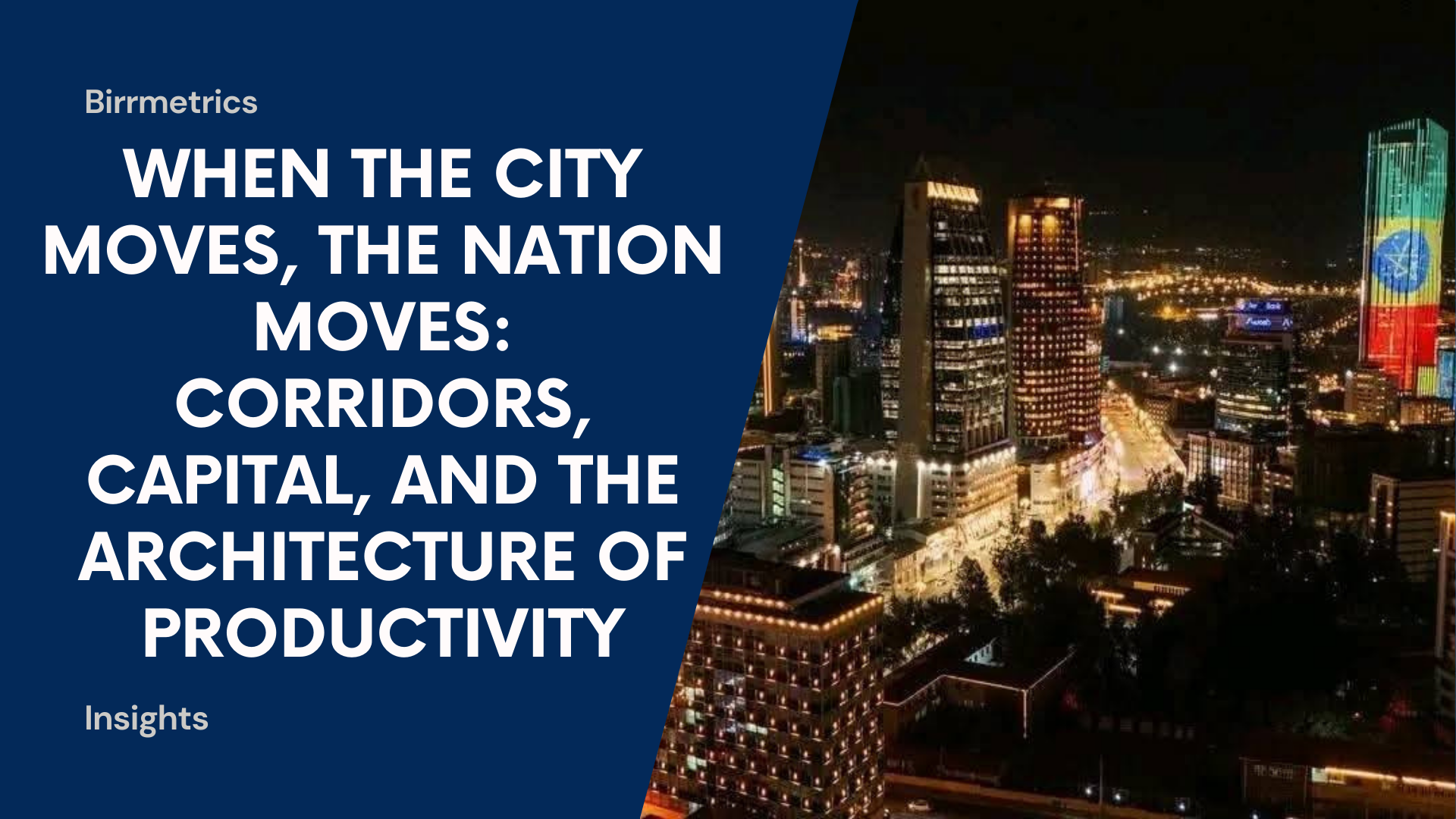
- A Respectful Rebuttal to Zelalem Tamir’s “Corridors Do Not Build Economies,” published February 27, 2026
With full respect to Zelalem Tamir’s economic training and the seriousness of his argument, this essay offers a rebuttal to his article, “Corridors Do Not Build Economies,” published on February 27, 2026. His piece is thoughtful, disciplined, and rooted in classical development economics. It deserves engagement, not dismissal. What follows is not a rejection of irrigation, renewable energy or human capital investment. It is a broader economic reflection on whether urban corridors belong on the side of symbolism, as he suggests, or whether they are in fact part of the productive architecture of a transforming economy.
In serious economic writing, certain words carry unusual weight. Words like but and just do more than connect clauses; they pivot entire arguments. They acknowledge one reality and then redirect the reader toward another. Zelalem employs that craft effectively. He opens with a cinematic portrait of Addis Ababa at dusk – fresh asphalt reflecting streetlights, riverbanks shimmering, cranes suspended against ambition. It is evocative and generous in tone. But then comes the pivot: development is not a photograph; it is a balance sheet. Policy must be judged not by visibility but by productivity. The rhetorical turn is elegant and intellectually disciplined. It invites us to look beyond glow and toward grain yields, kilowatts, skills, and structural resilience.
Yet economic systems are more complex than rhetorical pivots. When we say development is not a photograph, we imply that what is visible is superficial. When we contrast appearance with fundamentals, we risk assuming that urban transformation belongs to aesthetics while agriculture and energy belong to substance. The argument subtly creates a hierarchy in which corridors enhance visibility, but irrigation enhances productivity. That distinction feels intuitive, especially in a predominantly agrarian country facing fiscal constraint. And yet the economy is not a morality play between rural virtue and urban spectacle. It is a network of interdependent flows, and networks rise or fall on the efficiency of their connectors.
Productivity is not a single variable confined to farmland. Economists define productivity as output relative to input. In agriculture, it is the yield per hectare. In manufacturing, it is output per machine-hour. In services, it is the value per labor-hour. In urban systems, productivity often resides in time. Time saved is input reduced. Input reduction increases productivity. Consider a simple arithmetic exercise. If one million urban workers lose thirty minutes daily navigating congestion and inefficient mobility, that equals half a million labor-hours lost every day. Multiply that by 250 working days, and the economy forfeits approximately 125 million labor-hours annually. Even at modest output per hour, the cumulative loss is enormous. When corridors reorganize traffic flow, reduce travel time, and increase reliability, they compress friction. Transaction costs decline. When transaction costs decline, productivity rises without adding new land, new machines, or new workers. Irrigation may double yield per hectare, but corridors increase yield per hour. Both are productivity gains; they simply operate in different domains.
Not long ago, large sections of Addis Ababa effectively shut down by 5:00 pm. Congestion discouraged mobility. Lighting was uneven. Pedestrian infrastructure was limited. Economic life compressed into daylight hours. Shops closed early, not because demand vanished, but because the environment discouraged safe and efficient commerce. After corridor redevelopment, lighting improved, sidewalks expanded, and public spaces became navigable. Retail extended later into the evening. Hospitality expanded. In some areas, businesses adopted two shifts rather than one, not by decree but by feasibility. An economy functioning for eight hours produces less than one functioning safely for fourteen. If commercial hours expand by even 25 percent across thousands of enterprises and transaction volume follows proportionally, value-added tax collection increases correspondingly. If light industrial workshops operate double shifts because logistics reliability improves, output expands without additional land acquisition. Time once idle becomes productive capital. That is not symbolism. It is a recurring fiscal expansion.
Public health introduces another dimension rarely credited to urban design. Walkable corridors, green riverbanks, and organized pedestrian pathways encourage daily movement. Sedentary lifestyles contribute to chronic illnesses such as cardiovascular disease and diabetes, conditions that impose long-term costs on public healthcare systems and reduce effective labor participation. When urban infrastructure makes walking accessible and safe, behavioral patterns shift. Over time, reduced incidence of chronic disease lowers healthcare expenditures and increases labor productivity. These gains do not appear immediately in national accounts. They accumulate quietly, like compound interest. Healthier populations work more consistently and burden public finances less heavily. Urban design shapes health outcomes, and health outcomes shape economic performance. The connection is structural rather than sentimental.
Safety operates as economic infrastructure as well. Improved lighting and organized pedestrian spaces increase perceived and actual security. Safety extends commercial hours. Safety attracts families, tourists, and investors. Crime functions as a hidden tax on growth, imposing costs through lost property, insurance burdens, and deterrence of investment. When corridors reduce that hidden tax, they enhance productivity indirectly but materially. Safety is not ornamental. It is foundational to commercial confidence.
Tourism introduces a macroeconomic layer to this discussion. Ethiopia recently reported approximately $2.6 billion in tourism revenue within six months. Tourism is deeply sensitive to perception – accessibility, safety, urban coherence, and overall experience. It would be analytically simplistic to attribute the entire surge to corridor redevelopment. It would be equally simplistic to deny any connection. Even if improved urban experience accounts for a fraction of increased visitor retention and spending, that fraction contributes directly to foreign exchange reserves. In an economy navigating currency constraints, incremental foreign exchange inflows stabilize import capacity, ease exchange-rate pressure, and support debt servicing. Foreign exchange is macroeconomic oxygen. Corridors influence perception; perception influences tourism; tourism influences reserves. The chain is indirect but economically coherent.
Structural transformation further complicates the binary framing of agriculture versus corridors. Agriculture remains foundational. Irrigation stabilizes output and reduces vulnerability to erratic rainfall. Renewable energy diversifies supply. Human capital compounds over time. Yet no country has achieved sustained middle-income transformation through agricultural intensification alone. Structural transformation requires labor migration from low-productivity agriculture to higher-productivity urban sectors – manufacturing, logistics, hospitality, services, and technology. Industrial parks do not thrive in isolation; they require mobility networks. Vocational training requires labor markets capable of absorbing skills. Agro-processing requires reliable logistics corridors. Urban infrastructure functions as connective tissue in that system. It is not a substitute for agriculture; it is a prerequisite for scaling beyond it.
Land value capture introduces fiscal feedback mechanisms often overlooked in narrow cost-benefit calculations. Public infrastructure improvements increase surrounding land values. Governments can capture part of that appreciation through taxation or lease adjustments. Captured value can finance irrigation projects, rural electrification, and vocational programs. Urban capital formation can subsidize rural modernization if institutional design allows it. The debate, therefore, is not asphalt versus agriculture. It is governance versus misallocation.
Capital markets respond to signals of competence and continuity. Infrastructure modernization signals coordination and execution capacity. Sovereign risk pricing reflects perception. Even small reductions in borrowing costs compound into meaningful fiscal savings over time. Confidence reduces risk premiums. Lower risk premiums reduce long-term debt servicing burdens. Confidence is not vanity. It is an economic variable embedded in bond spreads and investment flows.
The temptation in development debates is to construct hierarchies: agriculture first, cities later; fundamentals first, aesthetics never. But economies are not linear sequences. They are interdependent systems in which yield per hectare, output per kilowatt, skill per worker, and time per transaction interact continuously. Remove irrigation, and food security falters. Removing education and adaptability weakens. Remove urban connectors and coordination collapses. Sustainable growth emerges from complementarity rather than exclusion.
Zelalem asks what remains when cranes depart, and asphalt fades. It is a powerful metaphor. If corridors were spectacle alone, little would remain. But if corridors reduce transaction costs, extend economic hours, improve health outcomes, enhance safety, increase tax collection, attract tourism, raise land values, and signal competence, then what remains is embedded structural efficiency. Arteries are rarely admired once laid. Yet without arteries, no organism thrives.
Corridors alone do not build economies. That statement is true. But economies without connective infrastructure rarely scale beyond subsistence. Development at its highest level is not a photograph nor a single balance-sheet entry. It is the architecture of movement – of goods, of labor, of capital, and of confidence. When the city moves smoothly, the nation moves with it. That is not aesthetics. It is economics in motion.
Mohamud A. Ahmed is a Columnist | Political and Security Analyst | Researcher at Greenlight Advisors Group – Somali Region of Ethiopia. He can be reached at owsdfund@gmail.com




