

For Ethiopia’s central bankers, the past year brought a rare piece of good news. Inflation, which peaked above 34 percent in 2022, fell to about 13 percent in 2025. In February 2026 the National Bank of Ethiopia (NBE) announced that it had dipped into single digits, at 9.7 percent. Officials were entitled to a modest celebration.
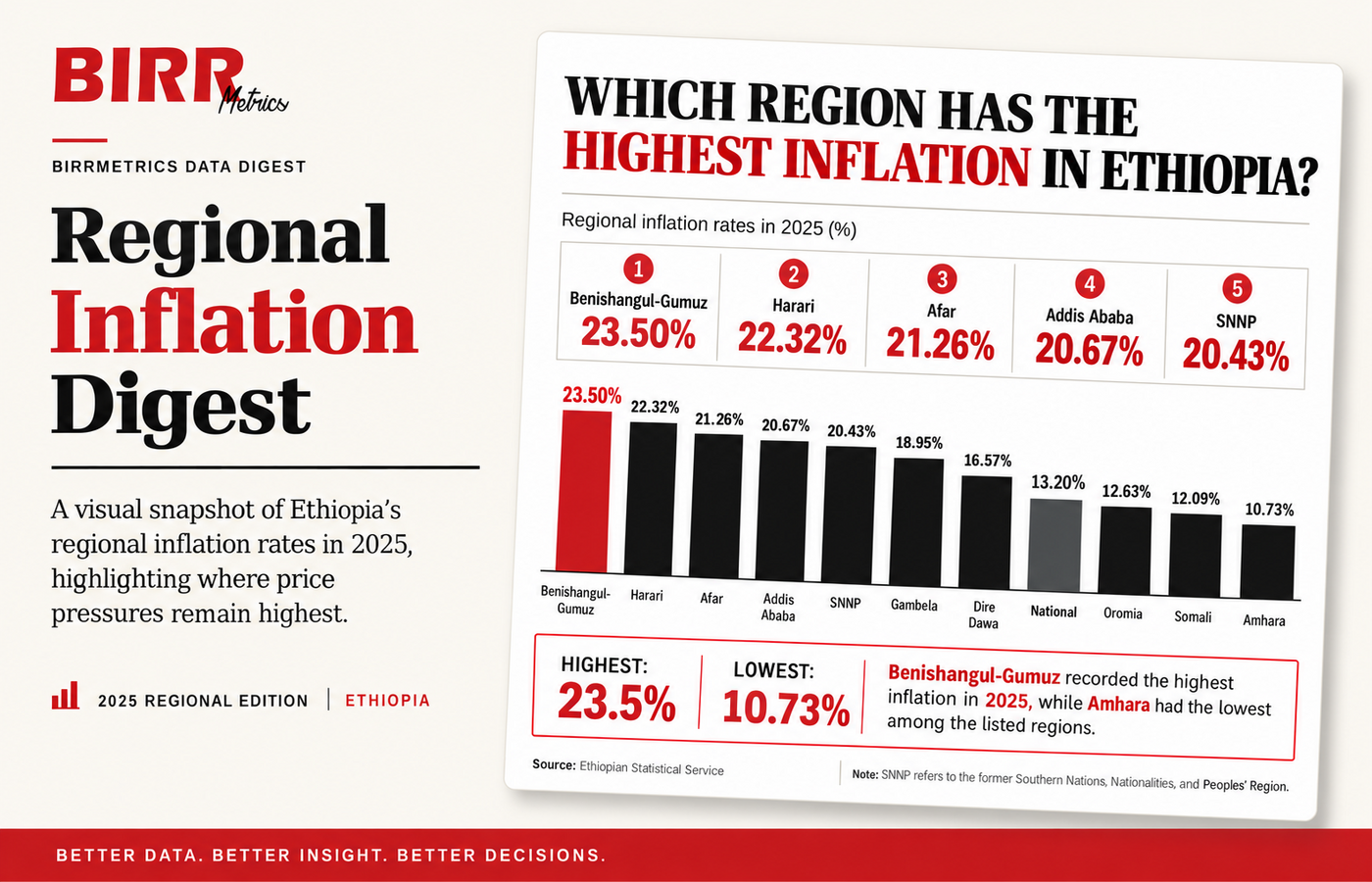
It did not last. By May inflation was back at 13.4 percent, up from 11.7 percent in April, as external pressures returned. And a closer look suggests the national figure was always a flattering summary. A new report from the Ethiopian Economics Association (EEA), a think-tank, breaks inflation down by region. The spread is startling. In 2025 prices in Benishangul-Gumuz, in the west, rose by 23.5 percent; in neighbouring Amhara they rose by 10.7 percent. Harari, Afar, Addis Ababa and the former Southern Nations region all exceeded 20 percent. Oromia and Somali hovered around 12 percent.
These are not separate economies. They share a currency, a central bank and, broadly, a fiscal regime. Yet prices in one can rise at more than twice the pace of the next. Benishangul-Gumuz’s misery is not new: between 2018 and 2025 its inflation averaged 25.6 percent a year, the highest of any region studied. Even Somali, the best performer, averaged 21.2 percent.
The explanation lies less in monetary policy than in geography. In a country of poor roads, frequent insecurity and thinly connected markets, inflation reflects the cost of moving goods as much as the quantity of money. Import-reliant places such as Harari, Dire Dawa and the capital are exposed to world commodity prices and the exchange rate. Farming regions suffer instead from bad harvests and seasonal swings.
That is why Addis Ababa, with the country’s deepest markets and best transport links, still endured inflation above 20 percent last year. The capital is well connected, but it produces little of what it eats or uses. When the birr weakens, fuel gets dearer or supplies from the provinces are disrupted, Addis feels it first.
The nature of the problem has shifted, too. In 2022 food was the chief culprit: food inflation reached 38 percent. By 2025 it had fallen to about 12 percent, while non-food inflation stuck at around 15 percent. In some regions the gap yawns. In Harari food prices rose by 13.5 percent last year; everything else rose by 32 percent. In Benishangul-Gumuz non-food inflation reached 28 percent.
Food prices are driven by harvests, fertiliser and the weather. Stubborn non-food inflation points elsewhere: to fuel, imported inputs, transport charges and the currency. In July 2024 Ethiopia abandoned its overvalued peg and let the birr move towards a market rate. The reform was overdue, but it made imports dearer, and fuel-price rises piled on. The EEA reckons the persistence of non-food inflation reflects these delayed effects.
Its econometrics paint a nuanced picture. Exchange-rate shocks nudge inflation up, though weakly and slowly. Money-supply shocks bite after three or four months and explain about 18 percent of inflation’s variation after a year. Neither the money-printers nor the currency-floaters can take all the blame.
None of this negates Ethiopia’s achievement. Dragging inflation from above 30 percent to the low teens is no small feat. Tighter monetary policy, a new policy rate, less central-bank financing of the government and calmer global supply chains all helped. But averages conceal. If big regions see prices settle while smaller ones still suffer rises of 20 percent or more, the national index can look benign while many households feel little relief.
A bigger worry is credibility. Of the 266 economists surveyed by the EEA, 57 percent think the official consumer-price figures unreliable. Some 71 percent say confidence in the birr as a store of value has weakened since the reforms, and 61 percent give low marks to the NBE’s commitment to lasting single-digit inflation. That is not proof the statistics are wrong, and the report is careful to say so. But perceptions matter. Traders who expect the birr to slide raise prices pre-emptively; landlords demand steeper rent increases; households buy ahead. Expectations of inflation have a habit of fulfilling themselves.
The data hint at this inertia. One month out, inflation’s own past explains 98 percent of its variation; even after a year it remains the dominant factor. Ethiopia is fighting not just high prices but the memory of them.
The regional figures expose the limits of monetary policy. The same interest rate applies in Benishangul-Gumuz and Amhara, yet one has inflation more than twice as high as the other. Closing that gap means better roads and storage, fewer internal trade barriers, more competitive wholesale markets and more productive farms. The EEA also urges bigger foreign-exchange reserves, credible fiscal consolidation and an independent review of how the consumer-price index is compiled. A central bank cannot anchor expectations with numbers that many informed observers doubt.
Then there is the hole in the table. Tigray is missing altogether: data collection there collapsed during the war, and no figures exist from 2022 onwards. Inflation statistics are meant to measure economic disorder. In Tigray the disorder grew severe enough to destroy the means of measuring it.
That is a reminder that price stability in Ethiopia depends on more than the central bank. Interest rates can curb demand. They cannot reopen blocked roads, rebuild ruined markets or persuade traders to haul goods through dangerous territory. In Ethiopia, peace is an anti-inflation policy. Until it holds, the government may win the argument over the national average while losing it across much of the country.




