

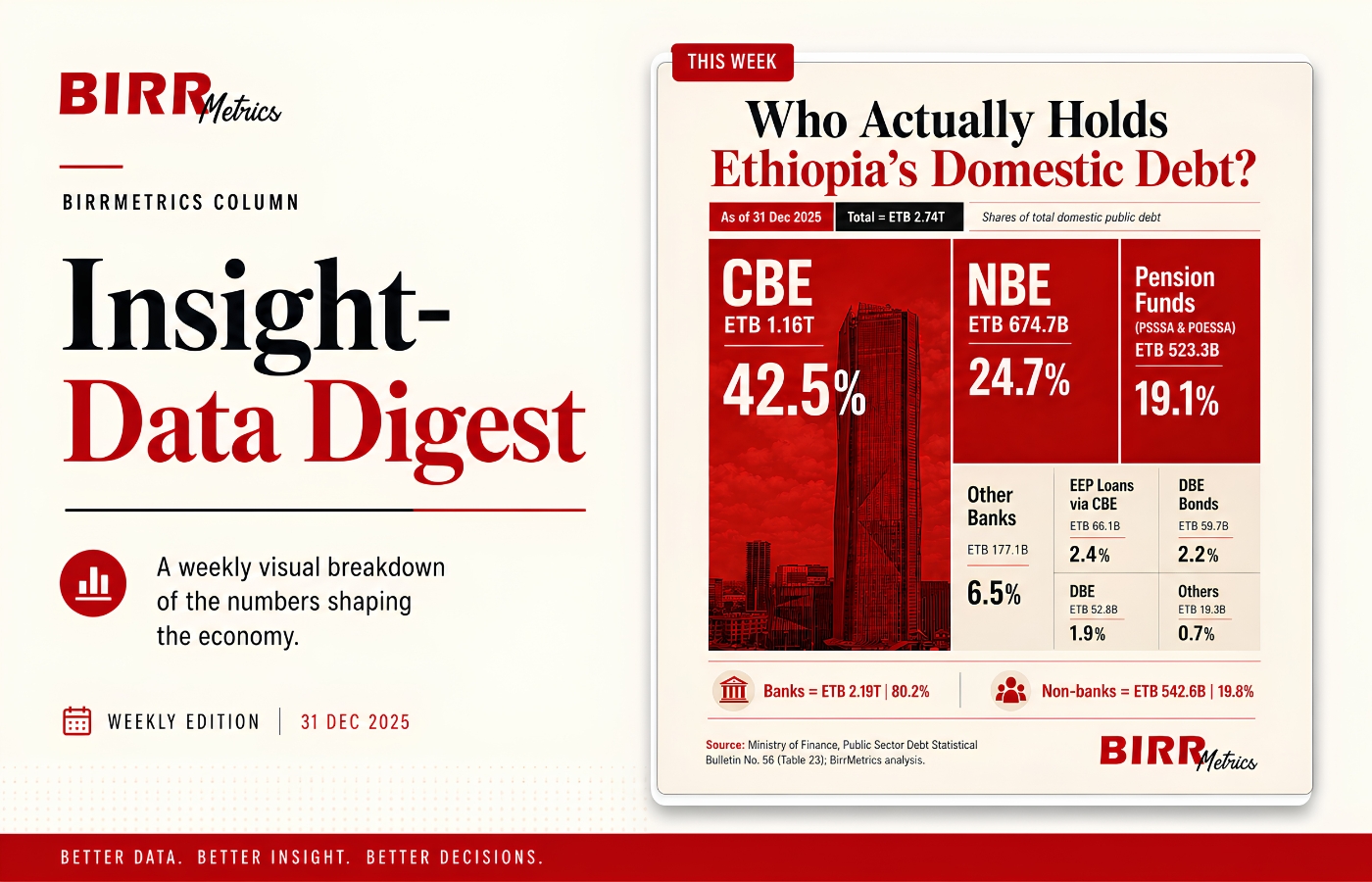
Ethiopia’s domestic public debt is increasingly concentrated in a small group of state-linked financial institutions, with the Commercial Bank of Ethiopia, the National Bank of Ethiopia and pension funds together accounting for close to nine out of every ten birr owed domestically.
Ethiopia’s domestic public debt reached 2.74 trillion birr at the end of December 2025, rising 5.9 percent from 2.58 trillion birr six months earlier. But behind the headline increase lies an even more significant feature of the government’s borrowing structure: who owns the debt.
Ministry of Finance data show that the domestic debt market remains overwhelmingly concentrated in banks and public institutional investors rather than being widely distributed across private investors, households, investment funds or a broad securities market.
At the centre is the Commercial Bank of Ethiopia (CBE).
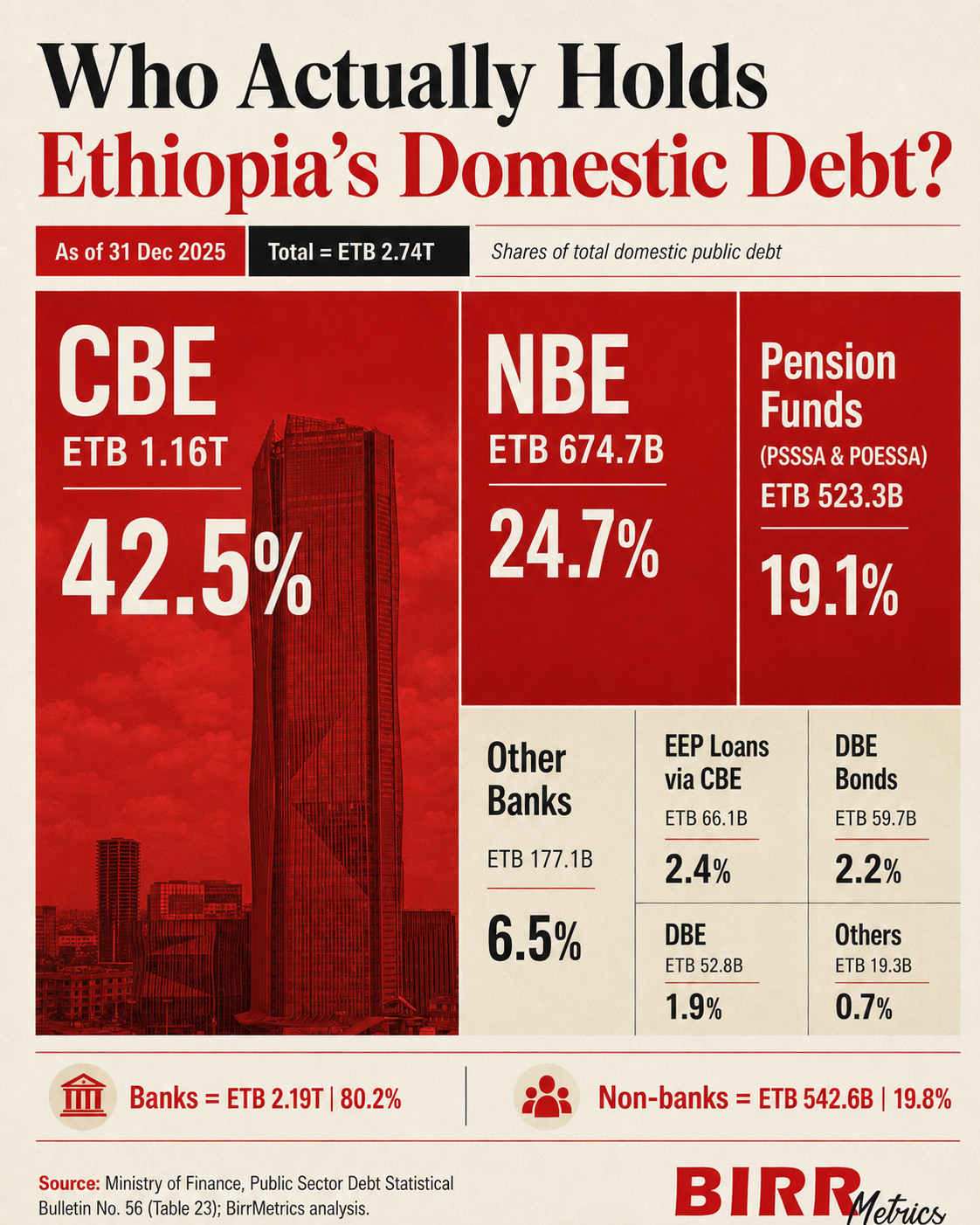
CBE held 1.16 trillion birr, or 42.5 percent, of central-government domestic debt at the end of December. In addition, another 66.1 billion birr of domestic public-sector debt consisted of Ethiopian Electric Power exposure through CBE. Taken together, CBE-linked claims amount to roughly 1.23 trillion birr, equivalent to almost 45 percent of all domestic public debt.
That means almost 45 cents of every birr-equivalent of domestic public debt is ultimately sitting on CBE’s balance sheet.
The National Bank of Ethiopia is the second-largest holder, with 674.7 billion birr, equivalent to 24.7 percent of the total. Pension institutions — PSSSA and POESSA — held another 523.3 billion birr, or 19.1 percent.
Combined, CBE-linked debt, NBE holdings and the pension agencies account for approximately 88.7 percent of Ethiopia’s entire domestic public debt stock.
That concentration is arguably the most revealing number in the domestic-debt statistics.
A debt market dominated by the state
The figures illustrate how different Ethiopia’s domestic debt market remains from a broad-based government securities market in which pension funds, insurance companies, commercial banks, asset managers, corporations and individual investors compete to finance the government.
Banks as a group account for about 2.19 trillion birr, or 80.2 percent, of the domestic debt stock. Non-bank institutions hold only 542.6 billion birr, or 19.8 percent — and almost all of that non-bank exposure belongs to the two social security institutions.
Even within the banking system, holdings are heavily concentrated.
Other commercial banks collectively held only 177.1 billion birr, equivalent to 6.5 percent of total domestic debt. DBE accounted for another 52.8 billion birr, while government-guaranteed DBE bonds amounted to 59.7 billion birr.
The result is a domestic debt structure built overwhelmingly around institutions that are themselves owned by, controlled by or closely linked to the state.
This creates a tight sovereign–financial sector nexus: the government depends heavily on the domestic financial system for funding, while major financial institutions carry increasingly large claims on the government.
CBE’s exposure has changed dramatically
The change becomes even more striking when compared with previous years.
In 2021/22, CBE held just 145.4 billion birr of central-government domestic debt. By December 2025, that figure had climbed to 1.16 trillion birr. NBE’s holdings increased from 357.4 billion birr to 674.7 billion birr over the same period, while pension-agency holdings rose from 237.4 billion birr to 523.3 billion birr.
But the surge in CBE exposure should not be interpreted entirely as new cash borrowed by the government.
A significant part reflects a major restructuring of public-sector liabilities.
The government issued 845.3 billion birr in 10-year securities to deal with CBE claims associated with the Liability and Asset Management Corporation and Ethiopian Electric Power. It also converted 176.8 billion birr of PSSSA Treasury bills and 89.5 billion birr of POESSA Treasury bills into 10-year government bonds.
In other words, part of the apparent transformation of the domestic debt market represents the transfer and consolidation of obligations onto the central government’s balance sheet, rather than simply a surge in conventional deficit financing.
This is also visible in the borrower composition.
Central-government liabilities accounted for only 61.4 percent of domestic public debt in 2023/24, while SOE debt represented 38.6 percent. By December 2025, the central government accounted for 95.4 percent, leaving SOEs with only 4.6 percent.
The debt did not simply disappear from public-sector balance sheets. A substantial portion changed form and borrower.
Why the concentration matters
The structure has important implications for both fiscal policy and financial-sector development.
Heavy government borrowing from banks can potentially constrain the amount of balance-sheet capacity available for lending to businesses and households, particularly if government securities become attractive relative to private-sector credit. The extent of that crowding-out effect, however, cannot be determined from the debt bulletin alone because it requires information on bank liquidity, credit growth, yields and private-sector loan demand.
There is also a market-development issue.
A deeper domestic capital market normally requires a broader investor base. Greater participation by insurers, pension managers, investment funds, corporations and eventually retail investors can improve price discovery, trading activity and the government’s ability to issue securities across different maturities.
The current figures instead show that Ethiopia’s domestic debt market remains highly concentrated.
And the government is still relying partly on compulsory mechanisms. A five-year government bond introduced in 2022 requires commercial banks to purchase bonds equivalent to 20 percent of their new loan disbursements; the outstanding stock of that instrument had reached roughly 203 billion birr by December 2025.
That makes the evolution of Ethiopia’s domestic debt market about more than the total amount borrowed.
The bigger question is whether the country can gradually move from a concentrated, institutionally driven financing system toward a genuinely market-based government securities market with a diversified investor base.
For now, the numbers tell a clear story: Ethiopia may owe 2.74 trillion birr domestically, but most of that debt ultimately leads back to just a handful of institutions.
CBE, NBE and the pension funds are effectively financing the overwhelming majority of it.
Source: Ministry of Finance, Public Sector Debt Statistical Bulletin No. 56; BirrMetrics analysis.




