Collections jumped by nearly 69 percent last year, but 10 companies supplied almost half of what the largest taxpayers paid
Ethiopia's taxmen have seldom had a better year. Revenue collections reached 1.518 trillion birr in the 2025/26 fiscal year, up 68.7 percent on the year before. Even after adjusting for inflation, collections grew by about 48 percent. A closer look, however, shows that the windfall rests on a remarkably small number of shoulders.
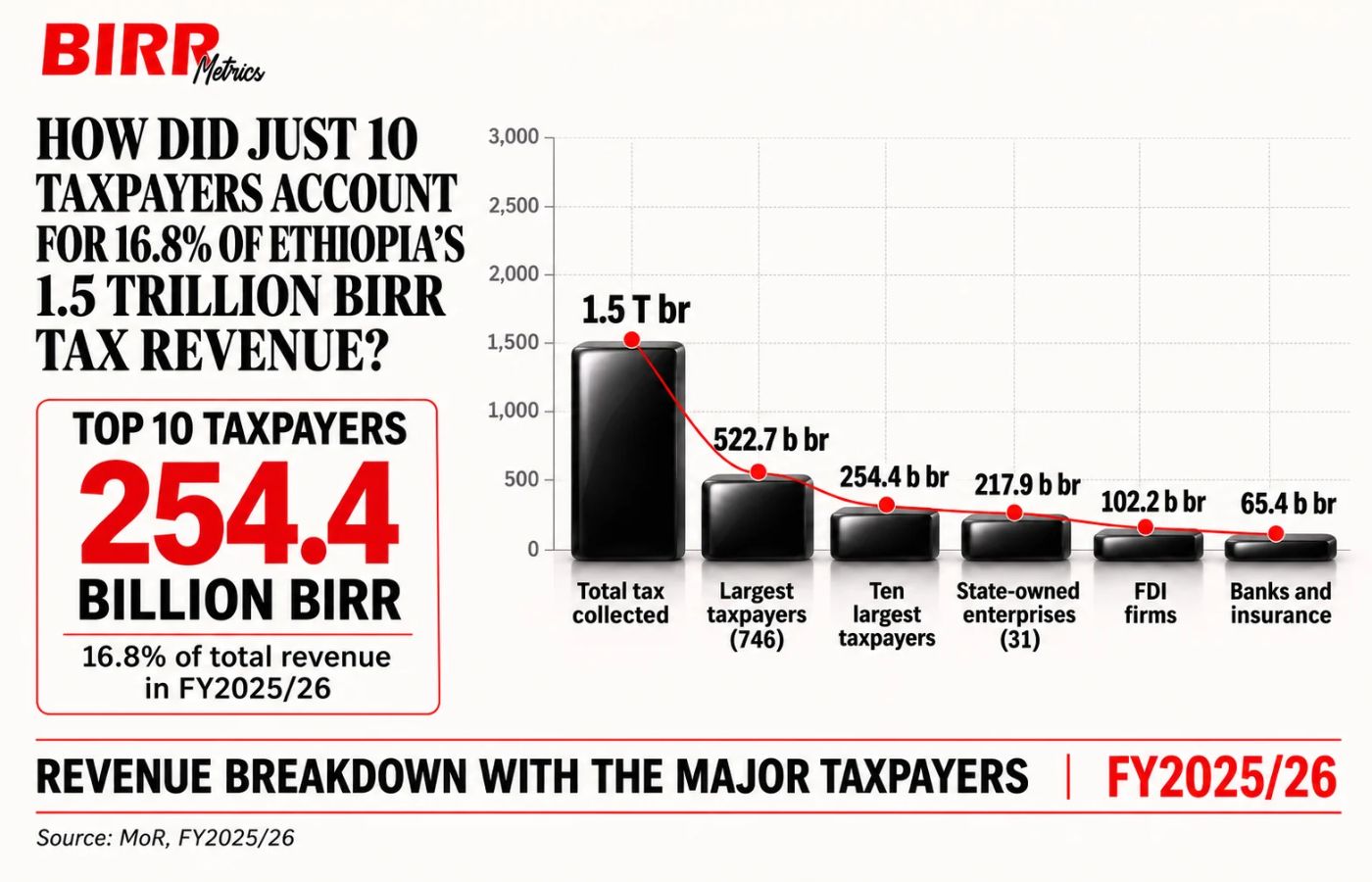
According to Cepheus Capital's latest macroeconomic review, the Large Taxpayers Branch of the Ministry of Revenues collected 522.7 billion birr from 746 registered taxpayers, or 34.4 percent of national collections. The concentration sharpens further up the ladder. The 10 biggest contributors paid 254.4 billion birr, equal to 48.7 percent of the branch's revenue and 16.8 percent of the national total. Put simply, 10 taxpayers generated nearly one birr in every six the state collected. The skew does not stop there: just 29 percent of the branch's registered taxpayers accounted for about 80 percent of its receipts.
The state is, in large part, taxing itself. Thirty-one state-owned enterprises paid 217.9 billion birr, roughly 42 percent of large-taxpayer collections and more than twice the 104.6 billion birr paid by 532 domestic private companies. The 127 foreign-invested firms in the branch contributed 102.2 billion birr, about a fifth of the total, while 50 banks and insurers paid 65.4 billion birr, or around 12 percent.
These gaps partly reflect size and sector. Large state enterprises, banks and foreign-invested firms operate at a different scale, and in different industries, from most domestic private businesses. Tax payments alone say little about relative compliance, profitability or productivity. Still, the figures show how heavily Ethiopia's revenue system leans on a thin slice of the formal economy.
That matters because the government wants much more. Stronger administration and enforcement, along with new measures such as the Minimum Alternative Tax and the Disaster Risk Management Fund contribution, have driven the recent gains. The tax-to-GDP ratio reached about eight percent in 2025/26, and the government aims to lift it to 10 percent by 2027/28 under its IMF-supported reform programme. The obvious question is how much more can be squeezed from a group of taxpayers that is already carrying so much of the load.
Cepheus Capital describes the concentration as a structural vulnerability. When so much revenue depends on so few enterprises, collections become exposed to swings in their profits, investment decisions and the fortunes of their sectors. A bad year for a handful of firms could become a bad year for the treasury.
The figures thus tell two stories. Ethiopia has become markedly better at collecting tax, but the base from which it collects remains narrow. The test now is not simply whether the government can raise more revenue, but whether it can spread the burden more widely as it does so.
The boom is real. Its base is not.