

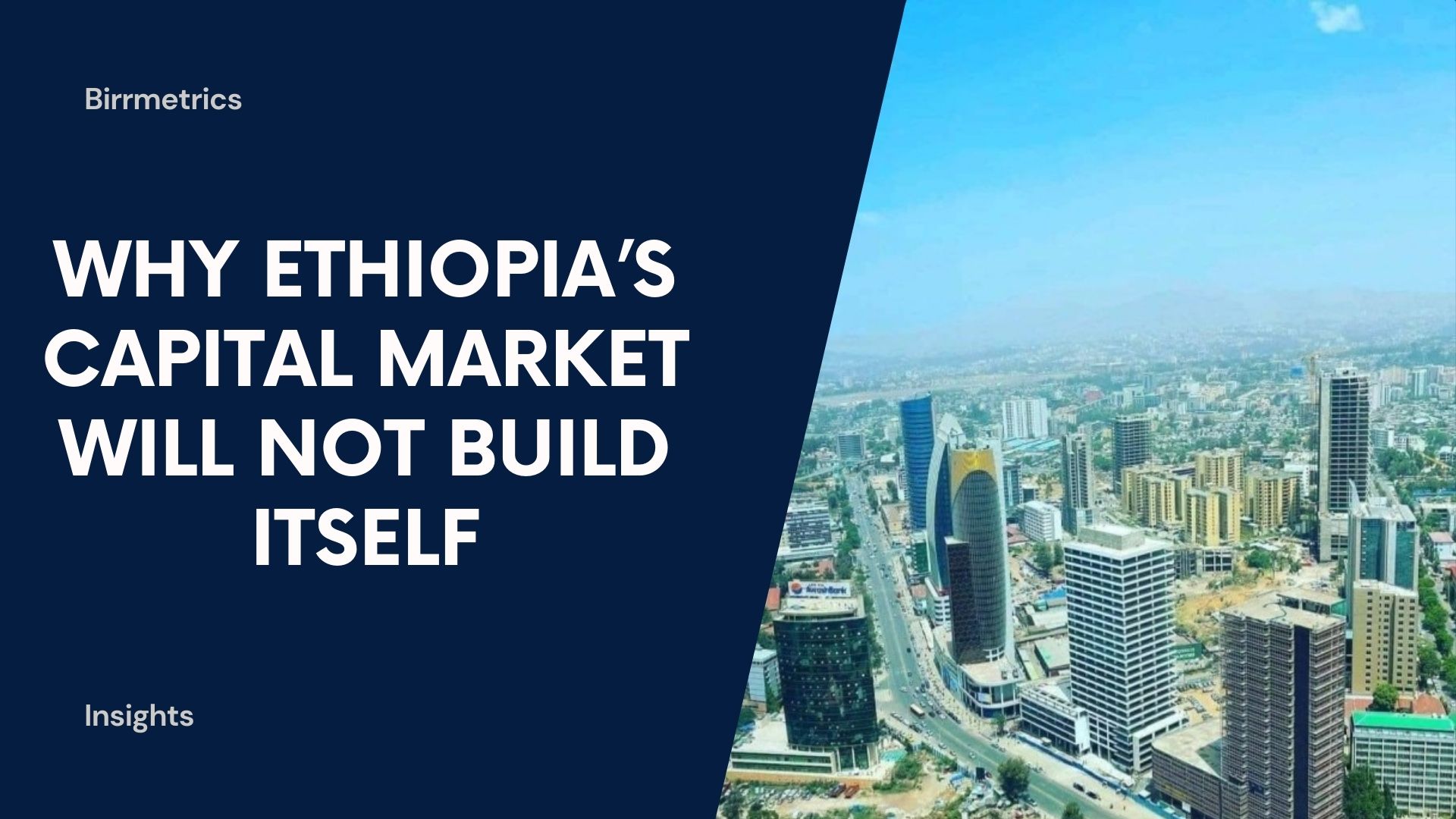
Ethiopia is taking its first steps toward a capital market economy as the Ethiopian Capital Market Authority prepares to open the Ethiopian Securities Exchange to trading. Wegagen Bank Share Company and Gadaa Bank Share Company have already listed, marking the initial phase of a transition that aims to shift the country away from a financing system dominated by banks.
Establishing a functional capital market is more than a financial milestone; it forms part of a structural transformation that could influence investment patterns across the economy. In contexts like Ethiopia, markets are not the product of spontaneous growth. They emerge through deliberate institutional design, carefully sequenced reforms, and accumulated expertise—a process economist Steve Vogel calls marketcraft.
The country’s challenge is not a shortage of ambition or domestic savings. Rather, it lies in the absence of an institutional framework capable of converting dispersed resources into productive, long-term investment. Capital markets are not mechanisms for reallocating surplus liquidity alone; they are systems that rely on the participation of millions of households, small businesses, and farmers. Integrating these actors into formal investment channels requires more than regulation, it requires analytical, informational, and organisational infrastructure that supports decision-making in an environment of uncertainty.
Several structural barriers impede this transition. Modern financial markets depend on complementary systems: auditing standards, payment and settlement infrastructure, disclosure regimes, retail distribution channels, and regulatory supervision. Private actors operating independently are unlikely to synchronise these investments, creating chronic underinvestment. Coordinated public leadership is essential to establish initial conditions that allow private initiative to flourish.
Reliable information is fundamental to the operation of any capital market. In Ethiopia, data transparency currently falls short of what investors require. Both private companies and government institutions must provide accurate and comprehensive information to the market. At present, many firms disclose selectively to shareholders and analysts, prioritising appearances over addressing underlying gaps. Capital markets cannot function effectively without audited financial statements, credit histories, sector benchmarks, and consistent disclosure. In their absence, risk cannot be priced accurately, and the cost of capital rises sharply. The constraint is not a shortage of funds, but a scarcity of credible information. Until this gap is closed, even well-established firms face prohibitively high financing costs.
Certain market-supporting services, such as rating agencies, investor education platforms, and data repositories, generate societal benefits that far exceed the returns captured by individual actors. Left to market forces alone, these services are consistently under-provided. Successful late industrialisers addressed this gap by treating these functions as quasi-public goods, developed through state-anchored institutions. Ethiopia faces a similar requirement.
Equally, expertise cannot be assumed. Valuation, risk modelling, portfolio construction, and regulatory oversight emerge through cumulative experience. Korea and Taiwan did not liberalise first and hope for capacity to appear. They built systems that generated skills before opening markets widely. Ethiopia must prioritise human capital accumulation rather than assume it exists.
At the core of Ethiopia’s challenge lies analytical infrastructure. Capital markets require valuation standards, historical return datasets, indices, ESG frameworks, and algorithmic safeguards. Without these, institutional investors cannot benchmark performance, early-stage firms cannot raise equity, and retail participation cannot scale. These are real, technical constraints that define whether the market can function.
Experience from peer economies reinforces this lesson. Taiwan’s Joint Commission on Rural Reconstruction built an information base for rural credit long before private actors entered. Korea institutionalised accounting and disclosure norms as prerequisites for market-based finance. These examples demonstrate that markets are deliberately manufactured institutions, not spontaneous phenomena.
Ethiopia’s path forward is clear. A balanced institutional ecosystem must be constructed. Shared infrastructure—including valuation databases, disclosure templates, credit registries, and indices—must anchor investment decisions. Human capital must be developed through structured programmes linking training directly to market operations. Anchor institutions such as development banks, pension funds, and postal savings systems must provide initial liquidity to stimulate private participation. Transparency, accountability, and reliable data must be progressively mandated, with transitional support for firms to adapt.
This is not interventionism in a simplistic sense. It is a disciplined, developmental strategy: building markets as public institutions that serve national transformation. Markets fail not because participants lack effort but because the institutional foundations are absent. A capable, strategic, and technically grounded state can create those foundations.
Ethiopia’s capital market will not emerge by chance. It will emerge because it is intentionally built, carefully designed, and systematically nurtured—a market capable of mobilising national savings, fostering investment, and shaping the country’s economic trajectory.
Bayu Samuel is a Strategy & Investment Analyst with experience across Ethiopia’s public and private sectors. He holds a BSc from Addis Ababa University and applies expertise in securities, financial modeling, and game theory to guide investment decisions. He is currently an Associate at ACE Investment and Impact Advisors and previously served as a Senior Analyst at the FDRE Land Bank and Development Corporation.




