

The missing middle of manufacturing is not finished goods. It is the spare parts, supplier firms and applied knowledge that keep factories alive.
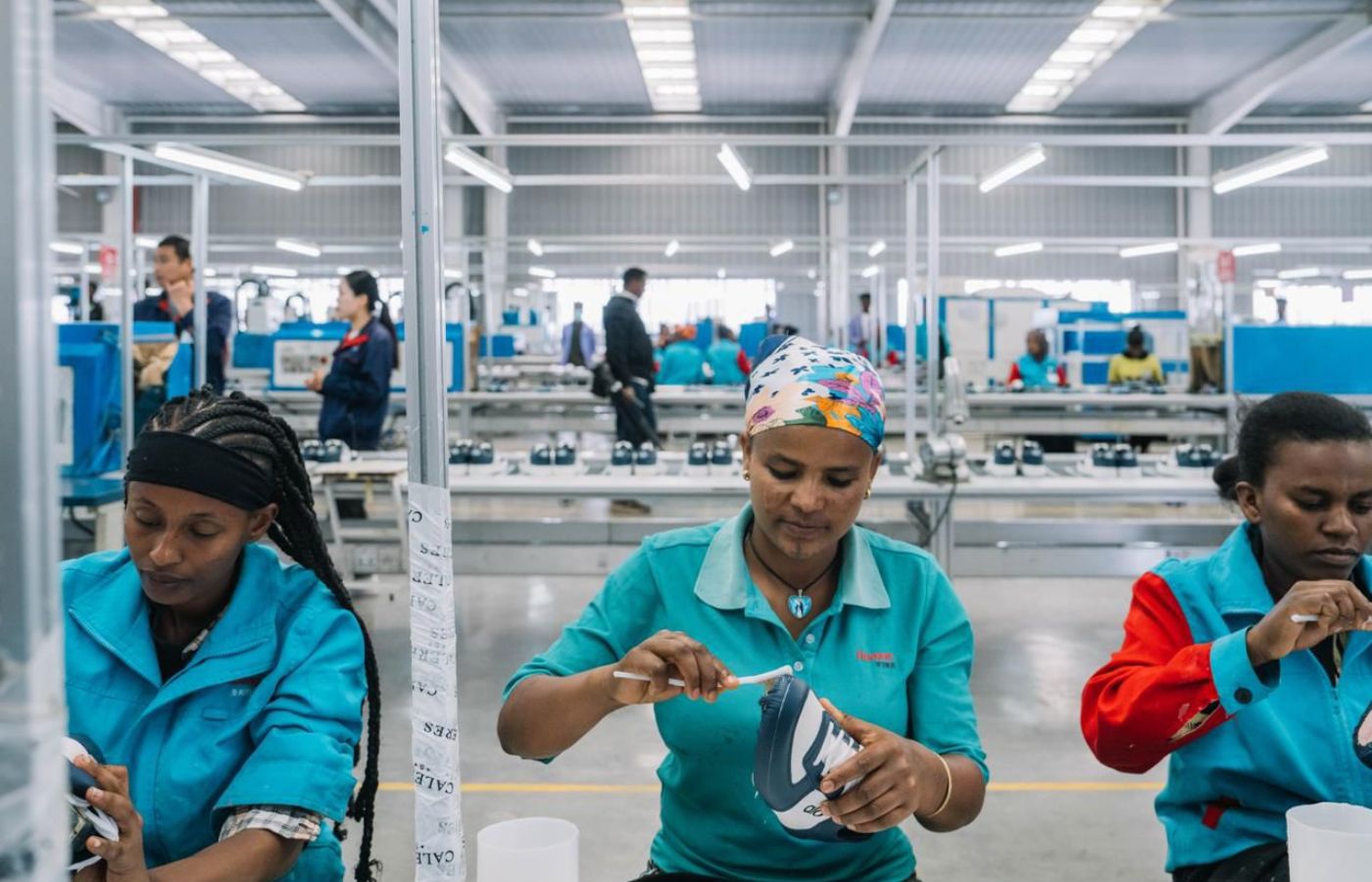
On a factory floor at the edge of one of Ethiopia’s industrial zones, a machine stops.
The immediate cause is ordinary: a worn bearing, a cracked mould, a dull blade, a broken valve. In mature manufacturing economies, the problem is often solved before it becomes a crisis. A local workshop machines the part. A supplier delivers a replacement. A maintenance team fits it before the next shift ends.
In Ethiopia, the same minor failure can begin a long and expensive journey.
The broken part moves from the factory floor to an importer’s ledger, then to a bank’s foreign-exchange queue, then to customs, then to an overseas supplier. Weeks may pass. Production stalls. Workers still need to be paid. Orders are delayed. Customers look elsewhere. A small steel ring becomes a macroeconomic problem.
Ethiopia talks often about industrialisation: garments, shoes, leather goods, agro-processing, pharmaceuticals and construction inputs. But far less attention is paid to the industrial ecosystem beneath those finished goods. The country still imports many of the ordinary parts that keep factories running: bearings, moulds, blades, valves, packaging components, machine tools and maintenance inputs.
This is the missing middle of Ethiopian manufacturing: the unglamorous but mission-critical layer of supplier firms, technical workshops, metallurgical capacity, precision machining and applied industrial research that allows a factory economy to breathe.
The weakness matters because manufacturing remains smaller than Ethiopia’s ambitions. World Bank data put manufacturing value added at about 4.4 percent of GDP in 2024. Government officials point to recovery under the “Made in Ethiopia” movement, including improved capacity utilisation and billions of dollars in import substitution. But the same official and parliamentary debates also expose a hard contradiction: factories are using scarce foreign exchange to import machinery, raw materials and spare parts while export earnings remain modest.
That contradiction is the story of the bearing.
Professor Daniel Kitaw, an industrial engineering researcher and manufacturing consultant at Addis Ababa University, has watched Ethiopia’s industrial promise advance slowly for decades. In his view, the usual explanations, foreign-exchange shortages, credit constraints and customs delays, do not go deep enough.
“In my assessment, the growth of Ethiopia’s manufacturing industry is among the slowest,” he said. “For anyone who has followed the industry since the Emperor’s time, its pace is very sluggish compared to the march of the modern era.”
The root problem, he argues, is not only capital. It is knowledge that does not reach production.
“The problem I raise, and as many research findings indicate, is that it is not knowledge-based,” Professor Daniel said. “It is a sector that desperately needs knowledge, yet we do not see industrialists applying it.”
He points to Japan as a contrast. There, he said, knowledge created in universities and research institutions is more likely to find its way into industrial use. “No knowledge is wasted,” he said. “Among the most carefully utilised knowledge is precisely that of this sector.”
Research on national innovation systems supports the broader point. Industrial innovation does not come from universities alone, or from factories alone, but from the link between universities, public research institutes and industry. Industry turns knowledge into products and processes, but universities and public research institutions strengthen the scientific and technical base that firms draw on.
In Ethiopia, that link remains weak. Studies are written. Workshops are held. Strategies are launched. Yet the same complaints recur: no local supplier, no reliable input, no precision machine shop, no standards lab, no patient finance, no technical bridge between research and production.
“It is impossible to remain perpetually dependent on imported spare parts,” Professor Daniel said. “So why do we expect change in this sector? By what standard is the expected outcome being measured?”
His prescription is direct: universities, technical institutes and factories must work together on specific industrial problems, and the government must help make that collaboration routine rather than ceremonial.
“We must create a situation where studies conducted in this sector are not wasted,” he said, “where knowledge is taken off the bookshelf, focused on current problems, and synthesised to nourish the industry.”
At the Ethio-Engineering Group, Temesgen Abrham sees the same gap from the factory side. EEG is one of the few institutions attempting higher-end engineering and machinery-related manufacturing in Ethiopia. But even where machinery can be designed or assembled locally, the broader ecosystem remains thin.
“The problems facing the manufacturing sector are many,” Temesgen said. “First of all, manufacturing is a demanding field. It requires technical knowledge. It is a sector that demands a high level of expertise.”
The paradox, he said, is that Ethiopia can produce some machines, but lacks the system that brings those machines, and the parts behind them, into regular industrial use.
“There is no clear pathway and no facilitation,” Temesgen said. “As long as we cannot replace imported spare parts locally, we cannot solve the underlying problem. In my belief, that is the crux of the issue.”
The obstacles are not only technical. Raw materials are difficult to source. Standards are inconsistent. Procurement systems often do not reward local experimentation. Banks are more comfortable financing trade than patient industrial upgrading. Small workshops may exist, but they rarely have the equipment, certification or quality-control systems required by larger factories.
“I am not confident that this has been achieved,” Temesgen said. “I also do not think the government has a logic that speaks with certainty beyond reports expressed in numbers.”
Those numbers tell two stories at once.
The government says local manufacturing has substituted billions of dollars’ worth of imports. The Ministry of Industry’s import-substitution strategy identifies local production, innovation, value addition, supplier development, reverse engineering and public procurement as tools for building domestic manufacturing capacity. It also recognises the need to incentivise large local firms to become suppliers of inputs currently imported, and to attract investment into reverse engineering and new product development.
But the strategy’s existence also confirms the scale of the problem. Ethiopia has identified the right words. It has not yet built the workshop floor beneath them.
That is why the experience of other countries matters.
Vietnam faced a similar problem as it joined global value chains. It did not treat “supporting industries” as a side issue. Its policy framework defined them explicitly as industries that manufacture materials, accessories, components and spare parts used to assemble finished goods. The objective was not simply to attract foreign factories, but to upgrade domestic enterprises so they could become suppliers to those factories.
Thailand’s automotive experience offers another lesson. Studies of the Thai automotive value chain show that industrial deepening depends on backward linkages: local firms producing parts, components, materials and machinery for larger assemblers. A strong local supplier base can reduce costs, shorten delivery times, increase flexibility, raise domestic value added and reduce pressure on the balance of payments.
South Korea went further. Its industrial success was not just about protecting sectors or giving subsidies. It built institutions that linked research to industrial application, used pilot plants and public-private R&D programmes to bridge research and commercialisation, and tied state support to performance. Korea’s lesson is not that Ethiopia can copy its model. It is that industrial policy only works when it becomes a learning system.
Morocco’s automotive sector shows both the promise and the caution. Public-private coordination helped the country build an automotive supplier industry and attract large manufacturers, but research also warns that such industries can remain stuck in lower-value activities unless local firms are deliberately moved into higher-skill and higher-technology segments. More recent investments in Morocco’s automotive and electric-vehicle supply chain show the value of setting local sourcing targets and building supplier ecosystems around anchor firms.
The lesson across these countries is consistent: factories do not become competitive simply because a country declares an industrial policy. They become competitive when local suppliers, skills, finance, standards, logistics and applied research are organised around real production problems.
The World Bank’s recent work on industrial policy in Africa makes a similar argument. Industrial policy performs poorly when it is reduced to isolated sector choices. It works better as a system that connects infrastructure, trade rules, skills, finance and firm support, with feedback loops that allow policy to adjust to firm performance and needs.
Ethiopia’s manufacturing problem is therefore not simply that the country imports too much. It is that the industrial system has not yet learned how to replace the right imports in the right sequence.
Import substitution can easily become a slogan. The harder question is which imports should be substituted first, by whom, with what standard, using which raw materials, financed by what instrument, tested in which lab, and linked to which guaranteed demand.
A bearing is not just a bearing. It requires metallurgy, measurement, heat treatment, precision machining, quality assurance and a buyer willing to trust a local supplier. A mould requires design software, tool steel, skilled machining and repeated testing. A blade requires material knowledge and consistency. A packaging component requires not only production but also standards, scale and reliable delivery.
That is why small and medium manufacturers should be central to the story. Across Addis Ababa’s industrial zones and workshop clusters, the very firms that could become suppliers to larger manufacturers often remain stuck between informality and industrial capability. They are too small to meet factory standards, too underfinanced to upgrade, and too disconnected from large buyers to justify investment in better machinery.
Asefa Worku, an industrial investment advisor, sees the situation as a painful irony.
“Seeing small and medium enterprises waste away due to lack of market and quality problems seems to me to stem from a lack of understanding of the industry’s nature,” he said. “The purpose of establishing small enterprises must be to deliver measurable economic benefits. The waste observed among small and medium enterprises is the source of this problem.”
Asked whether Ethiopia’s SMEs can currently feed larger manufacturing firms, his answer was blunt.
“I would say no,” he said. “This requires policy reform.”
Economist Fasil Tadese breaks the problem into three failures.
The first is Ethiopia’s weak transition from agriculture into agro-processing. The country has raw materials, but does not reliably convert them into higher-value industrial inputs.
The second is the failure to implement import substitution in a disciplined way. That requires institutional coordination, clear prioritisation and a practical understanding of which industries can build domestic capability. Fasil argues that Ethiopia’s efforts have too often narrowed into visible sectors such as textiles while neglecting the supplier base beneath production.
The third failure is the export trap. If factories turn outward before they have reliable inputs, supplier depth and productivity, they quickly face the same constraints: foreign exchange shortages, weak credit supply, imported inputs and inconsistent quality.
“These problems have plagued Ethiopia’s manufacturing sector for years,” Fasil said. “It is still common to hear about them. Hence, the importance of research is widely raised. That is what is observed in Ethiopia.”
The research gap is visible in the data. Ethiopia’s latest Global Innovation Index country profile puts gross expenditure on research and development at 0.27 percent of GDP in 2017, with only about 90 researchers per million people. By comparison, Japan spends more than 3 percent of GDP on R&D, Korea nearly 5 percent, and Brazil around 1.2 percent. The more important contrast is not only the amount of money. It is who uses the research. In Japan and Korea, the private sector accounts for a large share of national R&D. In Ethiopia, the bridge from laboratory to factory remains fragile.
A recent World Bank Economic Review study on Africa’s manufacturing puzzle also helps explain Ethiopia’s difficulty. The study notes that Ethiopian manufacturing has historically played a marginal role in employment, exports and output, and has fallen short in stimulating domestic linkages. It contrasts African manufacturing patterns with Asian cases where structural change and within-sector productivity growth moved together.
That is the missing middle in another language: weak domestic linkages.
A factory that imports its machines, inputs, maintenance parts, packaging and technical services may assemble goods in Ethiopia, but much of the industrial learning remains elsewhere. A country can count the factory, count the workers and count the output, but still miss the deeper question: how much capability has stayed behind?
This is where Ethiopia’s current reform moment should be judged. The “Made in Ethiopia” movement has helped bring manufacturing back into public debate. Officials say capacity utilisation has improved and hundreds of firms have entered production. The government also claims large savings from import substitution. These are not minor achievements.
But the next test is harder. Ethiopia must move from celebrating finished goods to building the industrial base that makes finished goods sustainable.
That requires a supplier-development agenda with teeth.
Large factories should be mapped against the imported parts and maintenance inputs they use most frequently. Local workshops should be assessed honestly against those needs. Universities and technical institutes should be given specific industrial problems, not broad research themes. Public procurement should create demand for local parts where standards can be met. Banks should finance upgrading contracts, not only import transactions. Standards bodies should help firms certify components. Industrial parks should host repair, tooling and maintenance clusters, not only assembly sheds.
And government should measure success differently. Not only by the value of imports “substituted,” but by the number of certified local suppliers created, the reduction in machine downtime, the share of locally sourced maintenance inputs, the number of factory problems solved through university-industry collaboration, and the survival rate of SMEs upgraded into supplier firms.
Back on the factory floor, the broken bearing still sits in a cardboard box.
No local workshop can replicate it to specification. No supplier has the metallurgical process. No bank sees the business case. No research centre has been asked to solve that exact problem. No procurement system has created predictable demand for a domestic producer to try.
So the bearing travels abroad. The factory waits. The country spends foreign exchange to restart a machine that might have been repaired ten kilometres away.
The missing middle is not a conspiracy. It is a cumulative failure to connect knowledge to production, SMEs to large factories, research to industry, and policy to practice.
Until Ethiopia learns to make the things that make things, the machines will keep stopping.
One broken bearing at a time.




