

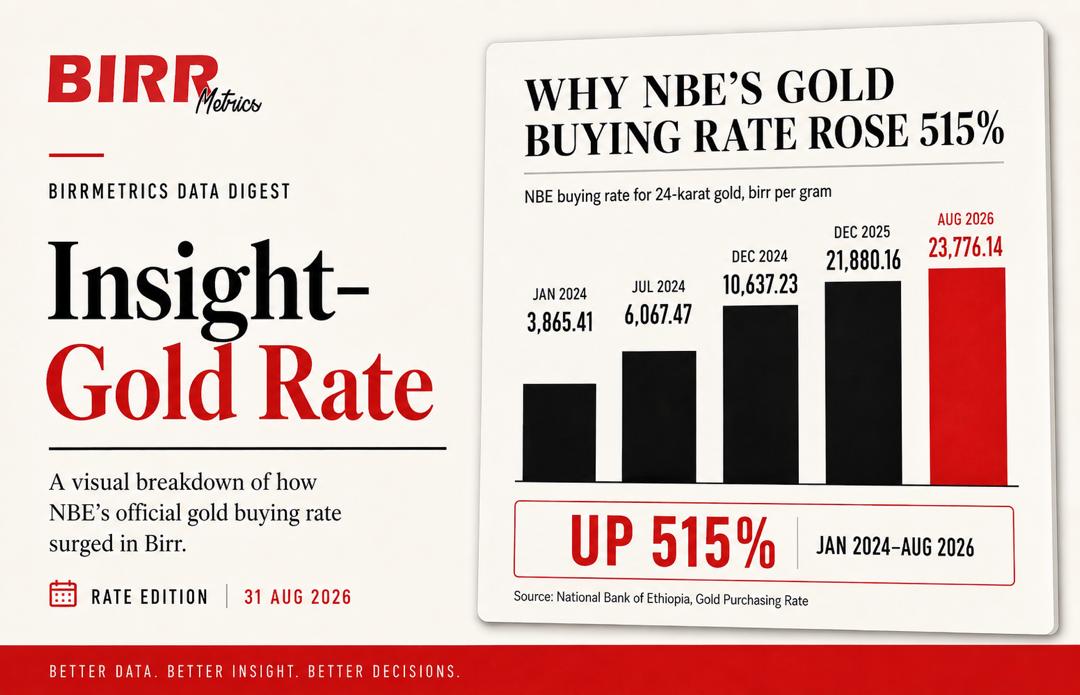
The National Bank of Ethiopia’s buying rate for 24-karat gold reached Br23,776 per gram on August 31, 2026, up from Br3,865 in January 2024. The increase of Br19,911 per gram—or 515 percent in less than three years—is striking even in an economy accustomed to rapidly changing prices.
But the rise is not simply a gold story. It is the combined result of a global gold rally, the depreciation of the Birr and the central bank’s effort to attract more domestically produced gold into official channels.
NBE’s rate for gold with a purity level of 99.96 percent increased from Br3,865 per gram in January 2024 to Br6,067 in July of that year. It reached Br10,637 by December 2024, more than doubled again to Br21,880 by December 2025 and climbed to Br23,776 by the end of August 2026.
The changes are visible in both components of NBE’s published rate: the international dollar price assigned to a gram of gold and the Birr value used to convert that price into domestic currency. NBE publishes both figures through its gold-purchasing-rate platform.
More than a global gold rally
The US-dollar component of NBE’s buying rate increased from 65.53 dollars per gram in January 2024 to 147.95 dollars in August 2026. That represents an increase of approximately 126 percent.
Over the same period, the exchange rate embedded in NBE’s figures rose from roughly Br59 per dollar to nearly Br161 per dollar—an increase of approximately 173 percent.
These two changes multiplied each other. A gram of gold became more valuable in dollars at the same time that each dollar became worth considerably more Birr.
Using the proportional change in the two components, approximately 45 percent of the rise in the domestic gold rate can be associated with the higher dollar value of gold, while around 55 percent reflects the changing Birr-dollar conversion rate.
| Date | USD per gram | Implied Birr/USD rate | NBE rate |
| January 2024 | 65.53 | 58.98 | Br3,865 |
| July 2024 | 78.64 | 77.15 | Br6,067 |
| December 2024 | 84.01 | 126.61 | Br10,637 |
| December 2025 | 141.26 | 154.89 | Br21,880 |
| August 2026 | 147.95 | 160.71 | Br23,776 |
This decomposition is important. Without the international gold rally, the domestic price would still have risen sharply because of the Birr. Without the currency adjustment, global gold prices alone would still have more than doubled the rate. Ethiopia experienced both simultaneously.
The exchange-rate reform changed the trajectory
The most visible structural break occurred around the foreign-exchange reform introduced in July 2024.
Between January and July 2024, NBE’s gold rate rose by 57 percent, from Br3,865 to Br6,067 per gram. By December, only five months after the reform, it had reached Br10,637—a further increase of 75 percent.
Before the reform, the official exchange rate used to calculate the domestic value of gold was substantially below the rate available in the parallel foreign-exchange market. That created a strong incentive for producers, traders and intermediaries to sell gold outside official channels or move it across borders illegally.
Even when NBE added incentives to its gold price, an artificially strong official exchange rate could leave formal buyers unable to compete with informal dealers. Gold could fetch more Birr when its dollar value was converted using the parallel-market exchange rate.
The post-reform adjustment narrowed that distortion. A more market-responsive exchange rate allowed NBE to offer a Birr price closer to the economic value of the gold. The higher official buying rate is therefore partly the cost of moving gold from informal channels into the formal financial system.
Why NBE is willing to pay more
Gold occupies an unusual position in Ethiopia’s foreign-exchange system. NBE is not merely a regulator observing the market; it is the country’s sole authorised exporter of gold.
The central bank purchases gold delivered through official channels, pays suppliers in Birr and exports the refined commodity for foreign currency. That makes domestic gold acquisition part of Ethiopia’s foreign-reserve strategy.
The policy appears to have produced a significant supply response. In February 2025, NBE reported that record gold deliveries had increased the central bank’s gold stocks and pushed foreign-exchange reserves above its initial expectations. The additional inflows gave NBE room to conduct foreign-exchange auctions for commercial banks.
By March 2026, NBE said gold’s contribution to economic growth had increased from 0.1 percent in 2023/24 to one percent in 2024/25. The central bank attributed part of the mining sector’s stronger performance to the expansion of gold activity.
The rise in the buying rate should not automatically be interpreted as NBE “overpaying.” A higher Birr price may simply reflect the current dollar price of gold and the market value of the Birr. The relevant question is whether NBE can export the acquired gold at a value sufficient to cover the purchase price, refining expenses, transport costs, inventory losses and other associated expenditure.
The programme’s rapidly rising financial cost
NBE’s audited accounts show how dramatically the scale of the gold operation expanded.
Gold purchase, refinery and related costs rose from Br6.92 billion in 2023/24 to Br315.56 billion in 2024/25. That was a 45-fold annual increase.
The central bank reported Br275.22 billion in revenue from gold sales during the same year. Its auditors also identified Br57.2 billion in losses associated with gold sales and the write-down of gold inventories to their net realisable value.
These figures should not be interpreted by simply subtracting gold revenue from gold-related expenditure. Gold purchased near the end of a reporting period may remain in inventory and be sold in the following year. The cost figure also includes refining and related expenses, while accounting write-downs can reflect changes in the value at which unsold stocks can be recognised.
Nevertheless, the figures show that gold is no longer a marginal operation on NBE’s balance sheet. It has become one of the central bank’s largest financial activities. NBE’s audited financial statements provide the detailed accounting treatment of the programme.
For comparison, NBE reported gold purchase, transport and related costs of Br25.48 billion in 2020/21. The latest annual expenditure is more than 12 times that amount.
The monetary-policy complication
Buying domestic gold requires NBE to inject Birr into the economy. When the central bank purchases gold from producers or intermediaries, it creates or releases local-currency liquidity in exchange for an external asset.
That transaction strengthens foreign assets but can also expand reserve money. Unless the liquidity is absorbed—or sterilised—through instruments such as treasury bills, central-bank securities, deposit facilities or foreign-exchange sales, it can contribute to broader monetary expansion.
NBE has openly acknowledged this tension. In December 2025, its Monetary Policy Committee said the rapid expansion of reserve money was mainly driven by gold-related foreign-exchange accumulation and the corresponding injection of local-currency liquidity. At that point, reserve money was growing by 67.3 percent year-on-year, while broad money had expanded by 38.8 percent.
By July 2026, the committee again reported that growth in reserve money was being driven primarily by the accumulation of net foreign assets arising from gold operations.
This presents NBE with a policy paradox. The central bank wants more gold because it generates foreign currency and strengthens reserves. But purchasing more gold requires injecting more Birr, potentially complicating its effort to reduce inflation.
Foreign-exchange auctions partly address this problem. When NBE sells foreign currency to banks and receives Birr in return, some of the liquidity created during the gold purchase is withdrawn again. Treasury-bill sales and other monetary instruments can provide additional absorption.
The success of the gold strategy therefore depends not only on how much gold NBE can acquire, but also on whether it can manage the resulting Birr liquidity without undermining price stability.
Who benefits from the higher rate?
For miners and formal suppliers, the increase represents a substantial improvement in Birr earnings. A supplier delivering one kilogram of qualifying gold would receive approximately Br23.78 million at the August 2026 rate, compared with Br3.87 million in January 2024.
Part of that apparent gain, however, compensates for inflation and currency depreciation. A miner may receive six times more Birr per gram, but the costs of fuel, machinery, imported equipment, transport and everyday consumption have also increased.
The higher rate can also affect local jewellers and consumers. When NBE’s official purchasing price rises, jewellers must compete with the central bank and formal aggregators for available gold. That can increase the domestic price of jewellery, raise working-capital requirements and encourage the recycling of existing ornaments.
For the government, the formalisation of gold sales may improve export reporting, traceability and foreign-exchange receipts. But higher official prices alone will not eliminate smuggling. Enforcement, transparent weighing and assaying, reliable payments, proximity of purchasing centres and confidence in formal institutions also influence where miners sell.
A reserve-building strategy with a price
The sixfold increase in NBE’s buying rate illustrates how deeply the domestic gold market has been reshaped by the interaction of global commodity prices and Ethiopia’s exchange-rate reform.
The policy has helped NBE compete for gold that might otherwise have remained in informal channels. It has brought record supplies into the central bank, strengthened foreign-exchange holdings and supported reserve accumulation.
But it has also transformed gold into a major source of balance-sheet exposure and monetary expansion. The central bank is now paying hundreds of billions of Birr for domestic gold, managing large inventories and absorbing the liquidity created by those purchases.
The Br23,776-per-gram rate is therefore more than the price of a commodity. It is also the price Ethiopia is paying—in local currency—to formalise gold production, obtain foreign exchange and rebuild its external reserves.




